
The Alan M. Voorhees Transportation Center (VTC) has released a new report examining the history of public transit funding in New Jersey and its lasting implications for system performance today. Sponsored by NJ TRANSIT, the report documents how past funding decisions have shaped the agency’s current operations and future opportunities.
Funding History
Since its inception in the Public Transportation Act of 1979, NJ TRANSIT has provided transportation to millions of New Jersey residents through its bus, rail, and light rail services. This history includes periods of ridership growth, service expansion, funding downturns, and shifts in performance.
Early History (1980s): NJ TRANSIT launches a major capital program to renew its aged fleet. From 1979 to 1989, the average bus fleet age falls from 13.5 to 4.5 years, and rail ridership rises 40 percent between FY 1983 and FY 1988 alongside improved on-time performance.
Funding Challenges (1990s): Insufficient operating funds—partially due to TEA-21—lead to significant capital fund diversions and debt accumulation. By 2001, the agency commits $125 million of annual Section 5307 capital funds to debt service through 2016.
Service Expansion and Debt Accumulation (2000s): NJ TRANSIT expands service through three major light rail projects. Between FY 1999 and FY 2009, operating expenses rise from $903 million to $1.83 billion, while fare revenue increases from $441 million to $828 million, producing a 145.7 percent rise in the operating deficit. During the same period, NJ TRANSIT’s debt grows from $351 million in FY 1996 to $1.65 billion in FY 1999 and reaches $3.57 billion by FY 2009.
Debt Management and Asset Deterioration (2010s): New Jersey reduces capital and operating subsidies as debt service absorbs a rising share of available funds. From FY 2010 to FY 2017, NJ TRANSIT reduces its debt by $2.09 billion (62%), and annual interest payments fall from roughly $100 million to $46 million. However, capital assets decline from over $10 billion to approximately $7.3 billion. Between 2010 and 2014, NJ TRANSIT commuter rail averages 200.6 major mechanical failures per year, rising nearly 29 percent to 258 from 2015 to 2019.
COVID-19 and Revitalized Funding (2020s): Ridership declines following the COVID-19 pandemic while operating expenses continue to rise. Federal and state capital and operating assistance help NJ TRANSIT withstand revenue losses and advances capital projects. After federal COVID funding ended in FY 2025, New Jersey approves a Corporate Transit Fee to keep NJ TRANSIT solvent and avoid drastic service cuts.
Funding Models
To ensure long-term stability, New Jersey and NJ TRANSIT must secure reliable internal and external funding to sustain operations and support future projects, including the Glassboro–Camden Line, the HBLR Northern Branch extension, new BRT routes, and important upgrades to existing facilities. Models to be considered include:
Development-Based Value Capture: Transit agencies such as WMATA, MARTA, and Maryland DOT have pursued joint development projects that leverage agency properties for lease revenue through transit-oriented development. Strategies to increase agency revenue include profit sharing, streamlined local regulations, and reduced timelines for internal approvals.
Tax-Based Value Capture: Transit agencies have also relied on tax-based value capture strategies, such as Tax-Increment Financing (TIF) and Special Improvement Districts (SIDs), to raise capital funds for service expansion or improvement projects. These approaches have generated up to 50 percent of capital funds for transit projects in Illinois, Washington, D.C., and Oregon. As of 2025, New Jersey lacks TIF-enabling legislation and transit-specific SID legislation.
Stable Funding Sources: To fully fund operations, transit agencies require stable, reliable revenue streams. Common major funding sources in the U.S. include sales taxes, property taxes, income taxes, and corporate taxes. Each source varies in stability, regressiveness, and political support. NJ TRANSIT currently utilizes corporate taxes, New Jersey Turnpike Authority funds, diverted clean energy funds, casino revenue taxes, and gas taxes.
Recommendations
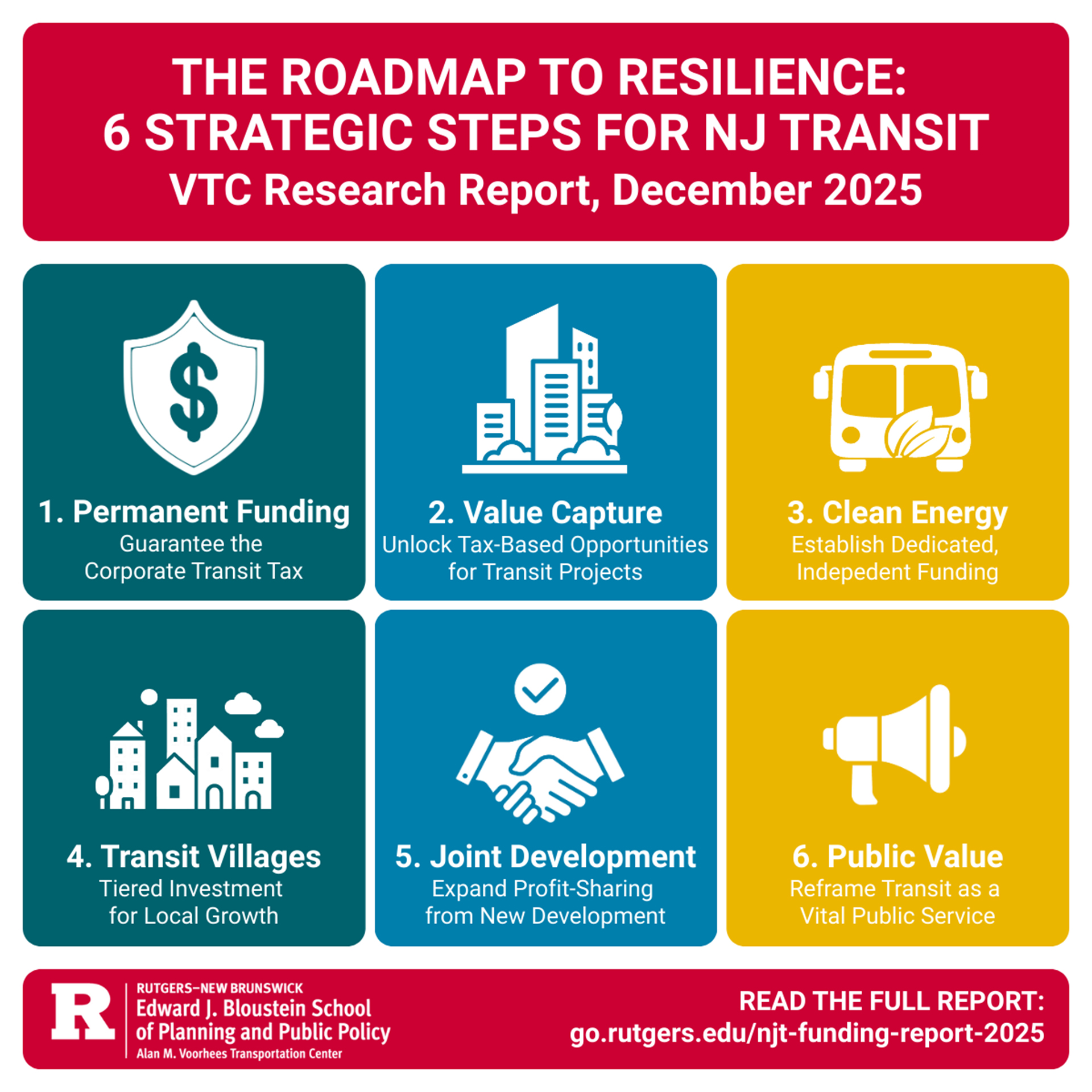
Drawing on NJ TRANSIT’s history, academic research, national case studies, and New Jersey’s current legislative landscape, several actions could help stabilize the agency and support long-term growth:
1. Constitutionally guarantee or extend the 2.5 percent Corporate Transit Tax.
2. Pass legislation that enables expanded tax-based value capture opportunities for NJ TRANSIT projects.
3. Create an independent clean energy funding source for NJ TRANSIT.
4. Expand the Transit Village Initiative through a tiered approach with additional investment opportunities for Transit Villages that meet defined benchmarks.
5. Design and expand profit-sharing opportunities for NJ TRANSIT’s future joint developments.
6. Publicize the value NJ TRANSIT creates beyond fare revenue generation and emphasize its role as a vital public service.