
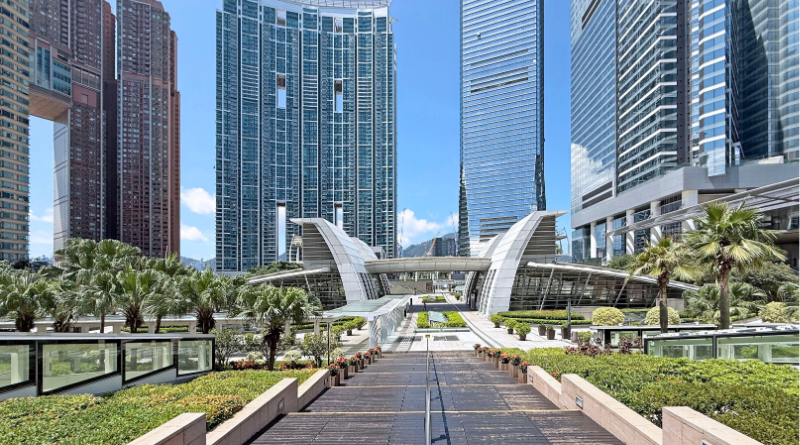
Kowloon Station in Hong Kong. Qwer132477 | Wikimedia Commons
Since Peter Calthorpe coined the term “Transit-Oriented Development (TOD)” in his book The Next American Metropolis, planners and urbanists have been enthralled by the concept. Calthorpe used the 3Ds—Density, Diversity, and Design—to define TOD, later adding Distance to Transit and Destination Accessibility. Now, three decades later, Ming Zhang introduces TOD 2.0, or Next-Gen TOD, to address limitations to the earlier framework and newly emerging challenges: growing income inequality, worsening climate crisis, and disruptive transportation technologies. To account for these challenges and opportunities, Zhang focuses on the core 3-Es: Efficiency, Equity, and Eco-Adaptability, while adding Evaluative and Educative elements to serve as additional analytical and participatory tools to inform planning and policy decisions. Zhang uses case studies from Hong Kong’s Kowloon High Speed Rail (HSR) and Austin, Texas’ affordable housing-focused TOD to demonstrate the Next-Gen TOD framework.
The goal of TOD 1.0 was to replace automobile dependency with walking, cycling, and transit use, enabled by dense, mixed-use development. Demand for land use patterns that embrace TOD has increased property values, helping justify infrastructure investment and capital improvements. However, its success also led to housing and commercial affordability challenges, displacing residents and businesses farther from transit. Additionally, despite lowering vehicle miles traveled (VMT), denser development can concentrate emissions and trap pollutants.
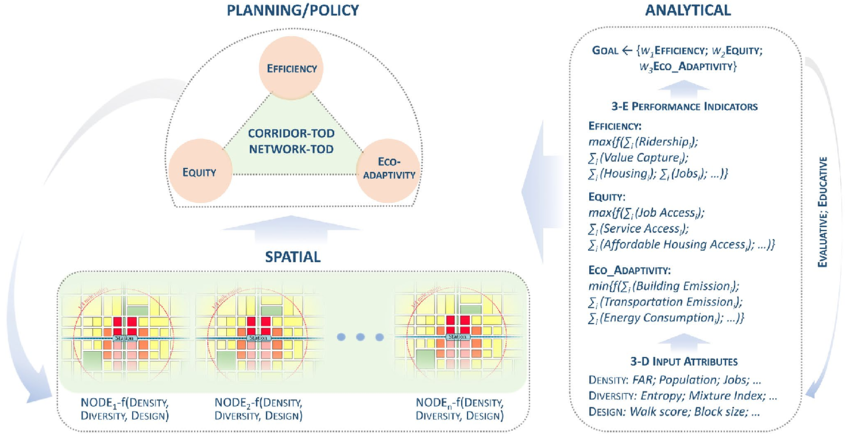
The Next-Gen TOD framework aims to foster a coordinated network of TOD nodes. Although Corridor TODs are not new, Zhang sees an opportunity to move beyond descriptive concepts toward meaningful coordination supported by analytics. The core 3-Es of Efficiency, Equity, and Eco-Adaptability are key to this shift. First, Next-Gen TODs must improve transportation and land use efficiency to overcome social and environmental challenges, using transit ridership, farebox recovery ratios, population, job density, and property values to measure success. However, this development must also be equitable, providing affordability for residents and business owners. Stakeholders can evaluate equity using the Housing + Transportation (H+T) Index and other metrics that track racial and income inequities. For eco-adaptability, strategies such as green buildings, green infrastructure, and low-carbon transportation can help reduce greenhouse gas emissions and improve air quality.
Lastly, Next-Gen TOD uses tools to evaluate plans and policies, ensuring decision makers are well-informed. Procedures and metrics can be used to compare the results of the 3-Es under various TOD scenarios, adjusting density, diversity, and design inputs as needed. This process is designed to enable adjustments that achieve a context-specific balance across performance indicators.
Hong Kong and Austin
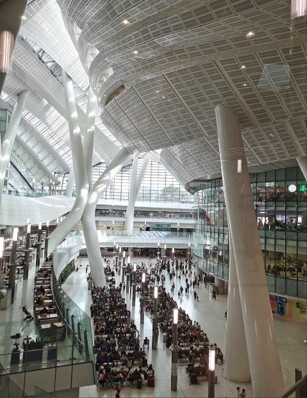
Hong Kong’s West Kowloon HSR station is a prime example of Next-Gen TOD principles. As of 2024, the station connected to 73 destinations in mainland China and served 188 trains, bringing 70,000 passengers into West Kowloon daily. The integrated TOD improves efficiency and accessibility by connecting riders to HSR via the Kowloon and Austin MTR stations, which are accessible through covered pathways. Connection to the Hong Kong Airport is available via the Airport Express, a 24-minute ride from Kowloon Station. Additionally, the Rail + Property (R + P) model has brought 1.7 million square meters of residential, office, retail, and hotel space to the station area, all housed in Hong Kong’s iconic International Commerce Center (ICC).
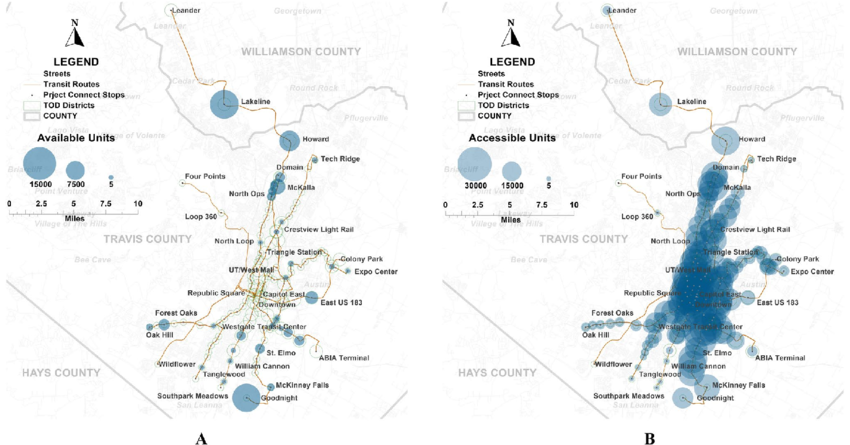
Officials in Austin, Texas have embraced NextGen TOD by planning for a more equitable city and engaging stakeholders in making it a reality. Following two decades of rapid population and job growth, Austin struggled with housing affordability. In 2017, the City of Austin adopted the 10-year Strategic Housing Blueprint, which called for the construction of 60,000 affordable housing units. Three years later, voters approved $7.1 billion in funding for CapMetro’s Project Connect plan to add two light rail lines, expand the commuter rail line, and create rapid bus routes. To promote equitable TOD (ETOD), the City engaged stakeholders on displacement-reduction strategies across the 133-station transportation network. Austin found potential for 61,097 to 70,411 affordable units within a half-mile of transit service. This development would also support 460,000 jobs and 535,000 monthly transit rides.
Conclusion
Ming Zhang’s Next-Gen TOD principles may prove critical as New Jersey faces its own ongoing affordability and environmental challenges. While at least 37 municipalities have embraced TOD 1.0 concepts and received Transit Village designation, many others may wish to consider how to create an efficient, equitable, and eco-adaptable TOD network while employing the tools to evaluate success.