
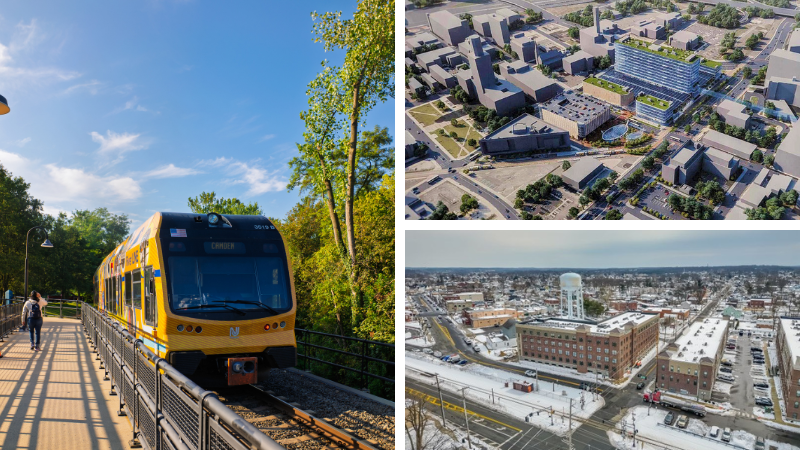
River LINE train at Bordentown Station. Courtesy of NJ TRANSIT (left); Walter Rand Transportation Center rendering. Courtesy of Gilbane Development; The Mill at Riverside. Courtesy of Kokes Properties (right top-to-bottom)
In 2004, NJ TRANSIT launched the River LINE along former Pennsylvania Railroad tracks that had not carried passenger service in more than 40 years. Funded entirely through the New Jersey Transportation Trust Fund, the 34-mile, $1.1 billion route became the nation’s first modern diesel light rail system. The River LINE functions more like a hybrid commuter rail service than a traditional light rail line, connecting Trenton and Camden while providing the only rail service for many communities along the Delaware River. The line also serves commuters traveling to Philadelphia through SEPTA or PATCO connections.
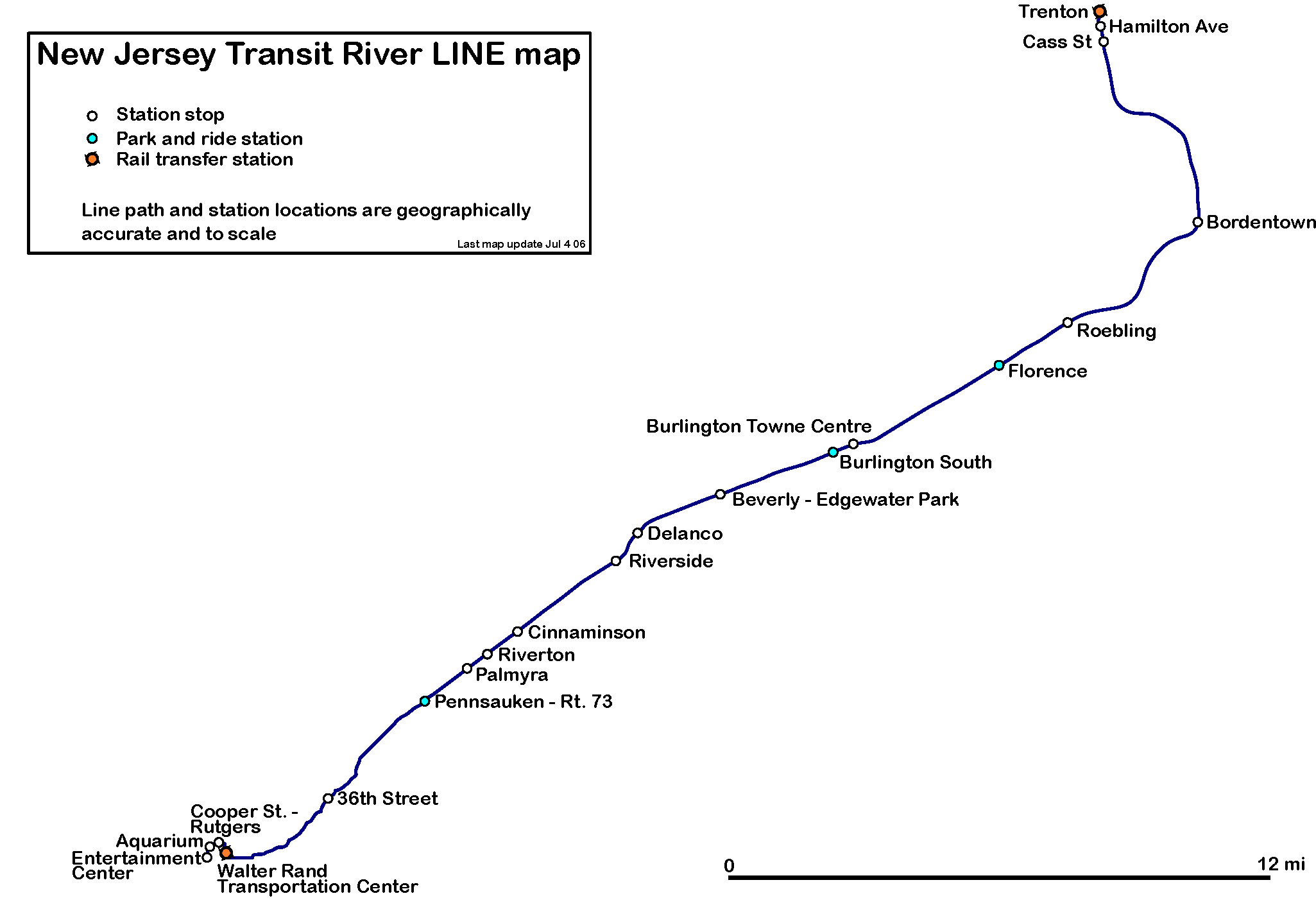
Over its two-decade history, the River LINE has faced recurring operational challenges. Most recently, the system has struggled to recover ridership following the COVID-19 pandemic. In 2025, the system recorded 1.6 million passenger trips, recovering to only 59 percent of its 2019 ridership levels, compared to 99 percent for the Hudson-Bergen Light Rail (HBLR) and 94 percent for the Newark Light Rail (NLR).
Service performance has also lagged behind other NJ TRANSIT light rail systems. In 2025, the River LINE recorded an on-time performance rate of 84 percent, significantly lower than the HBLR’s 97 percent and the NLR’s 99 percent. In response to these operational issues, NJ TRANSIT assumed direct control of River LINE operations from Alstom in September 2025. Previously, the line operated through a Design-Build-Operate-Maintain (DBOM) model, where NJ TRANSIT contracted daily operations to a private operator.
While service reliability remains an important challenge, land use patterns around many River LINE stations also limit the system’s long-term potential. Several stations sit adjacent to highways or industrial areas with limited pedestrian access. Others primarily function as park-and-ride facilities surrounded by surface parking lots and low-density development.
Research from the American Public Transportation Association (APTA), based on nearly 700,000 transit rider surveys across 163 transit systems, found that 69 percent of riders walk to transit, while only 11 percent drive. Additionally, 46 percent of riders reported having no access to a car. By emphasizing park-and-ride access, many River LINE stations may underserve the majority of transit users, particularly those who rely on transit as part of their daily mobility. Reliable transit service and transit-supportive land use often work together: compact, walkable station areas help support ridership, while stronger transit service makes those areas more attractive for investment and development.
Despite these challenges, several River LINE communities have pursued transit-oriented development and transit-friendly planning strategies to better leverage their stations. These efforts include the River Line’s two Transit Villages—Burlington and Riverside—as well as redevelopment initiatives in Pennsauken and Camden. As NJ TRANSIT works to improve River Line service, municipalities along the corridor may need to reconsider how station areas support housing, economic development, and pedestrian access. Transit-oriented development can diversify local tax bases, support local business, reduce traffic impacts from growth, and help preserve open space by concentrating development near transit infrastructure.
River LINE and Land Use
Using land use data from the NJ Department of Environmental Protection’s (NJDEP) Bureau of GIS, NJTOD analyzed land uses within a quarter-mile of stations on the River LINE, Hudson-Bergen Light Rail, Newark Light Rail, Northeast Corridor, and Raritan Valley Line. To maintain consistency, the analysis excluded immutable land uses such as rivers and tidal waters, which most significantly affected the River LINE and HBLR station areas.
Unsurprisingly, the HBLR and NLR—both fully urban light rail systems—contain the highest proportion of medium- or high-density residential, commercial, or mixed-use land near stations, at 60 percent and 65 percent, respectively. The Northeast Corridor and Raritan Valley Line recorded lower proportions at 49 percent and 39 percent. Along the River LINE, however, these transit-supportive land uses account for only 35 percent of station area land.
Satellite imagery reinforces these findings and highlights additional barriers limiting the River LINE’s development potential.
Trenton, one of the River LINE’s two principal urban centers alongside Camden, contains three stations, each facing geographical or land use constraints. Large parking structures and surface parking lots dominate the area surrounding the Trenton Transit Center, while highways divide nearby neighborhoods from the station area. Hamilton Avenue Station primarily serves the nearby CURE Insurance Arena, but the surrounding land largely consists of parking lots and highway infrastructure along NJ-129. Cass Street Station faces similar conditions, surrounded by industrial uses, parking lots, and limited pedestrian connectivity.
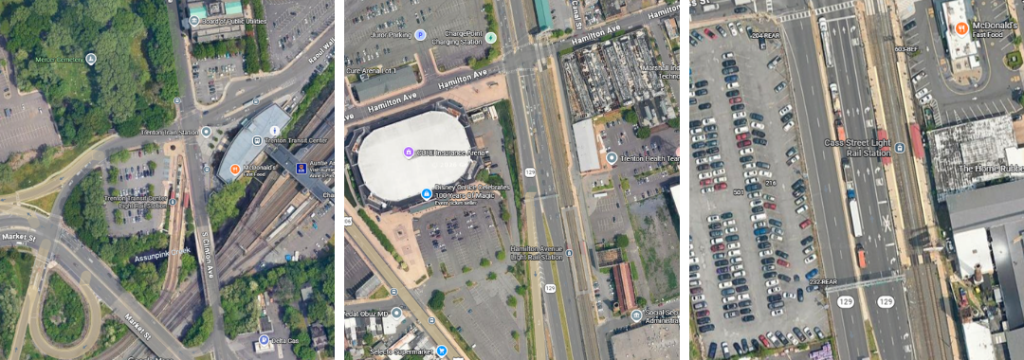
A review of station areas found that only 7 of the River LINE’s 21 stations operate within a traditional downtown or town center environment with visible transit-oriented development characteristics. Most stations remain surrounded by low-density development, large parking lots, or industrial land uses.
These development patterns have also limited one of the major economic benefits commonly associated with rail investment: increases in nearby property values. While projects such as the HBLR, Secaucus Junction, and the Montclair Connection generated measurable increases in surrounding property values, a 2010 study from the Voorhees Transportation Center found the River LINE produced no measured property value gains. The study identified low-density development patterns, limited pedestrian accessibility, and insufficient zoning changes to support transit-oriented development as key contributing factors.
At the same time, the River LINE has generated measurable benefits in some communities. An early analysis from the American Association of State Highway and Transportation Officials (AASHTO) found that the line increased residential property values in lower-income census tracts and supported approximately 630 jobs near stations between 2004 and 2009. Furthermore, municipalities that actively pursued redevelopment strategies have experienced economic growth and housing development along the River LINE.
Growth on the River LINE
Riverside
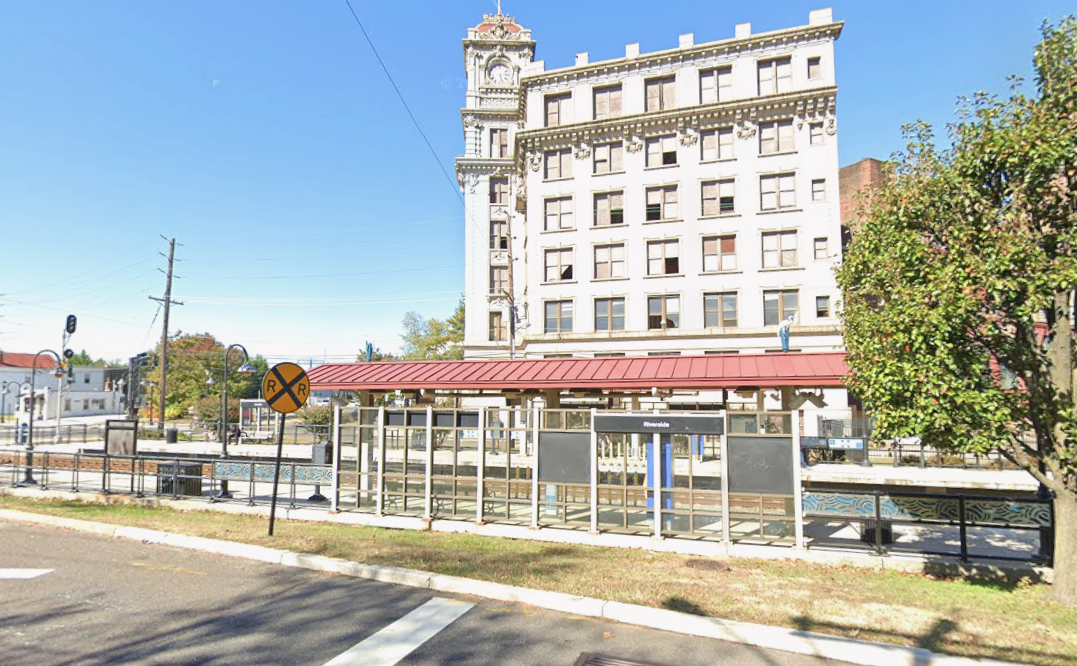
Riverside is a township of approximately 8,000 residents along the Delaware River. Its River LINE station provides direct access to the Walter Rand Transportation Center in Camden in approximately 22 minutes and to Trenton Transit Center in about 40 minutes, connecting passengers to Philadelphia, New York, and other destinations through PATCO, SEPTA, Amtrak, and NJ TRANSIT rail services. Additionally, nearly unique among River LINE stations, Riverside Station is located within the Township’s Central Business District.
Riverside received its Transit Village designation in 2001, even before the completion of the River LINE, based largely on plans to redevelop the 32-acre “Golden Triangle” industrial site. However, while Township officials made early efforts to encourage redevelopment around the station, Riverside experienced a common challenge to many larger projects: decades of stalled proposals and limited progress.
One of the Township’s largest redevelopment efforts involved the historic Keystone Watch Case Building, which has remained vacant for 70 years. In the early 2000s, Riverside approved redevelopment plans for the building, but little progress occurred over the following decade. In response, the Township purchased the building and surrounding property for $2.2 million in 2016 before selling the property at a low cost to a developer proposing 64 residential units. However, the project collapsed after that developer pleaded guilty to fraud in 2022. As of 2024, the property is owned by developer Sheharyar Shaikh, who continues pursuing redevelopment plans while addressing construction complications related to telecommunications equipment housed on the building’s roof.
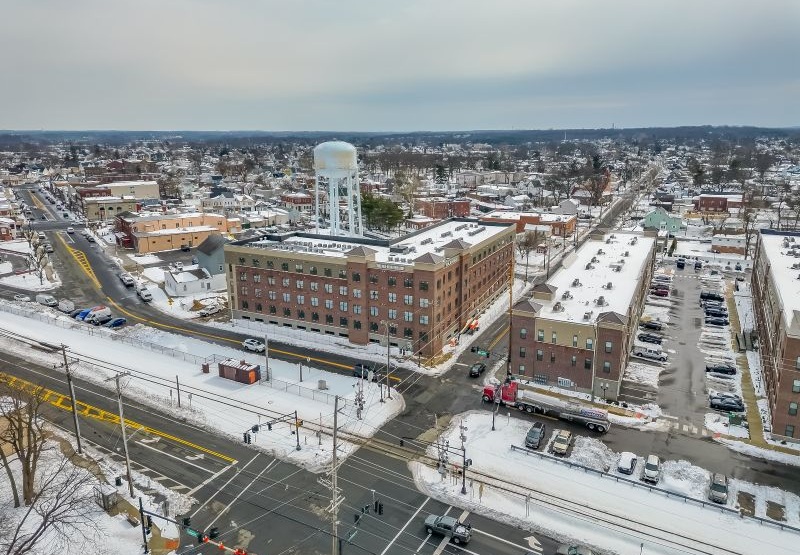
The Township also pursued redevelopment of the vacant W.F. Taubel Mills Factory property, which was demolished in 2006. Initial plans for residential development received approvals in 2008, but the project stalled for nearly a decade. In 2019, the Riverside Planning Board approved “The Mill at Riverside”, a 190-unit residential development from Kokes Properties. Unlike several earlier proposals, construction moved forward relatively quickly. Kokes Properties broke ground in 2020 and completed construction in 2026, with apartments opening for pre-leasing at the time of publication.
Riverside also attempted to advance redevelopment behind the Keystone Watch Case Building through Kaplan Companies’ proposed “Camelot at Riverside” project. Approved by the Planning Board in 2017, the proposal included 200 residential units on a 12-acre site within the Golden Triangle redevelopment area. To support the project, the Township approved a 30-year PILOT agreement set at 10 percent of the development’s $3.3 million projected annual revenue. However, soil remediation issues delayed the project in 2019, and no major updates have followed since.
Riverside’s experience demonstrates both the opportunities and challenges associated with transit-oriented redevelopment in smaller communities. The Township benefits from a walkable downtown, supportive local leadership, available redevelopment sites, and strong transit access. After years of stalled proposals, The Mill at Riverside represents a major step toward strengthening Riverside’s downtown residential base and supporting additional commercial activity near the station.
Additional redevelopment opportunities may also emerge through NJ TRANSIT’s LAND Plan initiative. Several agency-owned properties within the Transit Village district currently function as surface parking lots or are vacant, creating opportunities for future joint development projects.
Burlington
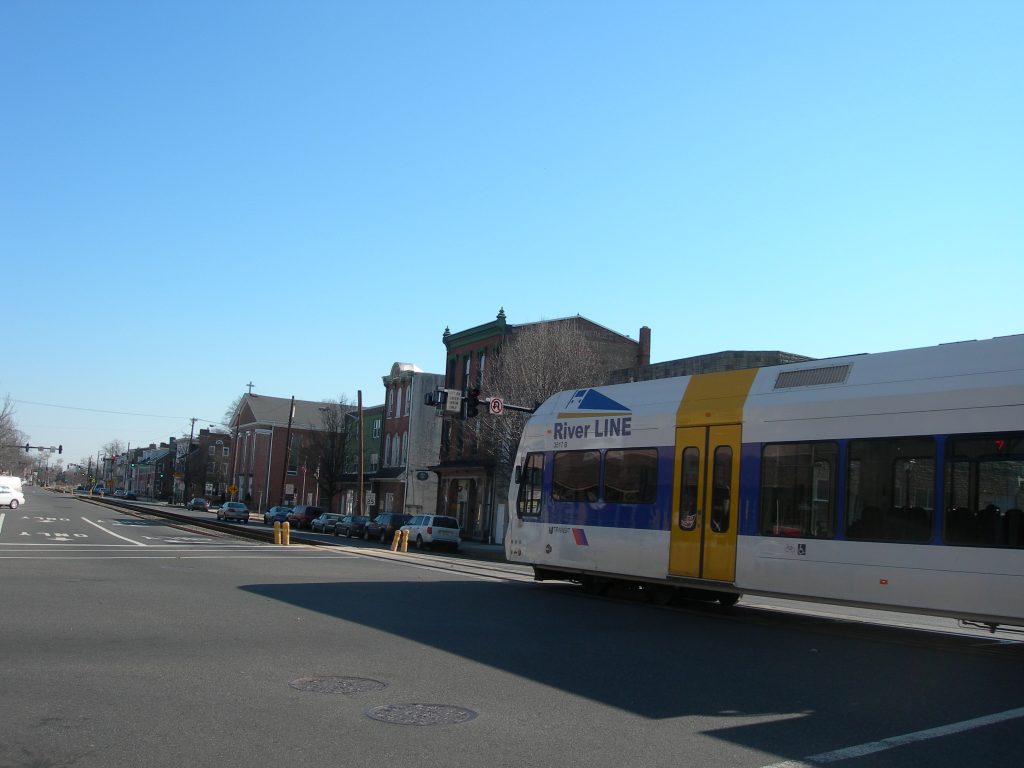
In 2007, Burlington became New Jersey’s 19th designated Transit Village and the second along the River LINE. The City of nearly 10,000 residents contains two River LINE stations—Burlington South and Burlington Towne Centre. Burlington Town Centre anchors the City’s Transit Village district and provides direct access to a walkable commercial corridor with local businesses and medium-density housing. Burlington South Station, by contrast, sits within a more industrial area and primarily functions as a park-and-ride facility.
Recent redevelopment efforts have focused on the New Yorkshire neighborhood, designated as an Opportunity Zone in 2019. While the Burlington Towne Centre Station is not located within the Opportunity Zone, much of the surrounding Transit Village district overlaps with the zone, strengthening the area’s appeal for transit-oriented development.
The Opportunity Zone’s first major development arrived in 2021 with the completion of the 184-unit Pearl Pointe Apartment Complex. Located less than half a mile from Burlington Towne Centre Station along the Delaware Riverfront, the market-rate development represents a significant investment in the neighborhood and an important step in broader revitalization efforts.
The City also continues exploring redevelopment opportunities involving publicly-owned vacant land and underutilized parking lots. Priority redevelopment areas include the riverfront, North High Street, and the Route 130 corridor, where transit access, commercial activity, and redevelopment potential overlap. Additionally, Burlington officials have identified the NJ TRANSIT-owned parking lot near Burlington South Station as a possible redevelopment site, although surrounding industrial land uses and large-format retail may complicate future projects.
Beyond station area redevelopment, Burlington has used its Transit Village designation to secure funding for pedestrian and streetscape improvements. In FY2026, Burlington received $275,000 to improve pedestrian safety near the Pearl Pointe Apartments at the intersection of Pearl Street and St. Mary Street.
Pennsauken
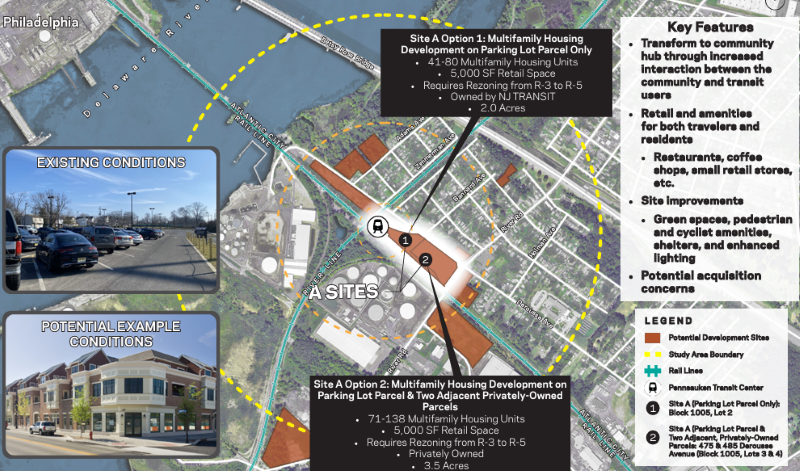
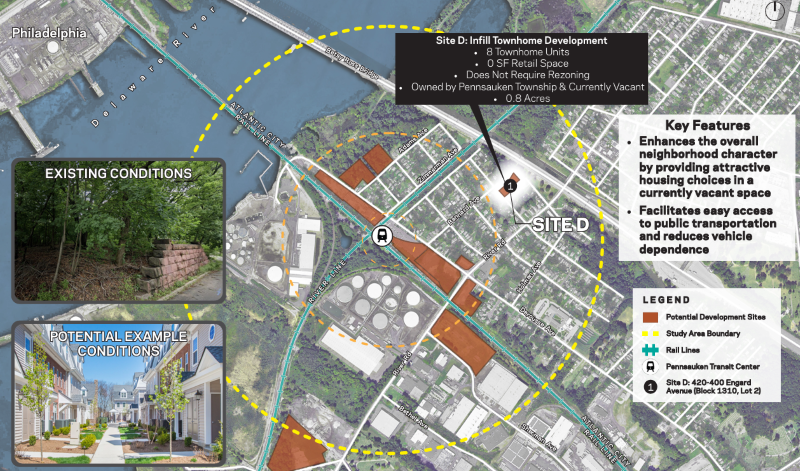
Pennsauken, home to nearly 37,000 residents and two River LINE stations, has recently partnered with NJ TRANSIT’s Transit Friendly Planning Program (TFP) to explore opportunities for transit-oriented development near the Pennsauken Transit Center.
Opened in 2013, the $40 million Pennsauken Transit Center serves as one of South Jersey’s largest multimodal transit hubs, connecting the Atlantic City Rail Line (ACL), the River LINE, and several bus routes. Despite significant investment, ridership has remained limited. In 2023, average weekday boardings reached only 71 on the ACL and 121 riders on the River LINE in 2023, well below the projected 570 daily riders. Surrounding land uses largely consist of vacant parcels, low-density residential development, and underutilized properties.
In 2023, NJ TRANSIT received funding from the Delaware Valley Regional Planning Commission (DVRPC) to conduct a transit-oriented development study for the station area. The study evaluated parcels within a half-mile radius of the transit center and concluded that restrictive zoning regulations limited redevelopment opportunities and constrained ridership growth.
The study identified two transit-agency-owned properties, including an underutilized parking lot, as strong candidates for redevelopment with the potential to support approximately 80 residences and 5,000 sq. ft. of commercial space. Pennsauken officials have authorized a study to explore potential zoning and permitting changes that could support future transit-oriented development at the station.
Camden
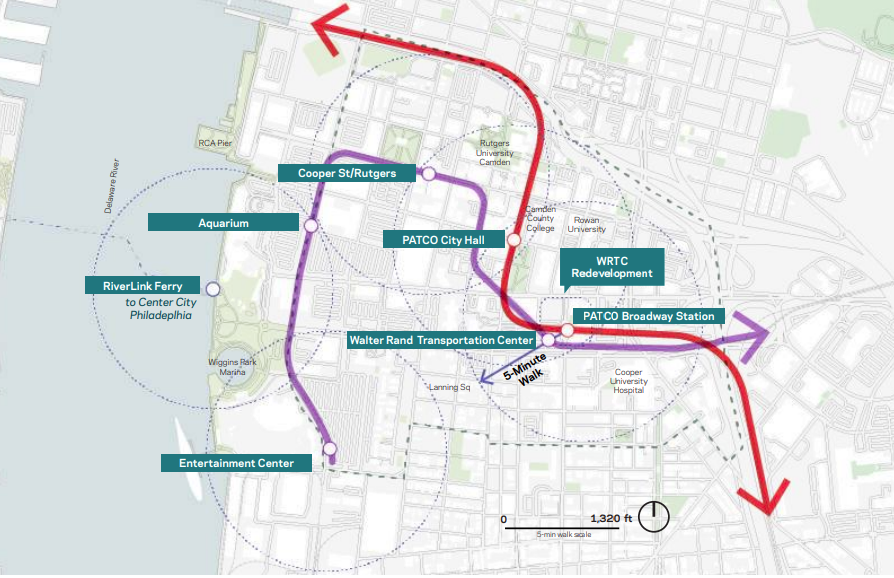
With nearly 72,000 residents and a population density exceeding 8,000 people per square mile, Camden is one of the River LINE’s two principal urban centers alongside Trenton. The City contains four River LINE stations in addition to PATCO service, creating one of southern New Jersey’s strongest transit networks. Additionally, the Camden Loop microtransit service helps support first/last-mile trips.
Despite these transit assets, Camden experienced decades of population decline and economic disinvestment during the second half of the 20th century. Like many industrial cities in the Northeast and Midwest, Camden lost major manufacturing employers as industries relocated or closed, weakening the city’s economy and contributing to long-term declines in population and household income. Camden’s population fell by nearly 42 percent from more than 124,000 residents in 1950 to around 71,000 in 2024.
The city also became nationally associated with high rates of violent crime during the 1990s and early 2000s, a reputation that continues to shape public perceptions of Camden. In recent years, public safety trends have shifted. Through policing reforms, community engagement efforts, and broader redevelopment initiatives, Camden has recorded substantial reductions in violent crime.
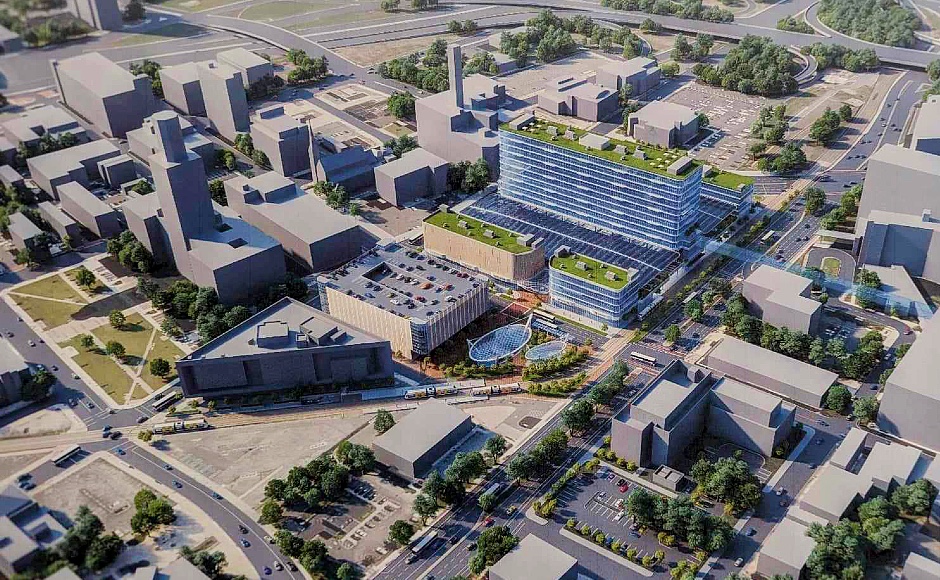
Camden’s improving conditions, combined with extensive transit access and proximity to Philadelphia, have strengthened opportunities for transit-oriented development. One of the largest current projects is NJ TRANSIT’s Walter Rand Transportation Center Improvement Project, a $250 million initiative to modernize Camden’s primary multimodal transit hub while supporting development nearby. Plans for the project include expanded transit capacity, improved pedestrian connections, full ADA accessibility, and a proposed 25-story “Beacon Building,” which would be the tallest structure in South Jersey. The tower is expected to include major institutional tenants such as Cooper University Health Care and potentially Rutgers University, further reinforcing Camden’s role as a regional healthcare and education center.
Other transit-oriented projects have emerged elsewhere in the city. In 2025, Virtua Health and The Michael’s Organization opened Oliver Station, an all-affordable, mixed-use development located next to PATCO’s Ferry Avenue Station. The project includes 47 apartments for seniors earning less than 60 percent of the Area Median Income (AMI) and a 5,200 sq. ft. ground-floor primary care facility—one of the first supported by NJHMFA’s new Hospital Partnership Subsidy Program.
Additional redevelopment is planned near Ferry Avenue Station through Parkside Place, which received an $18 million Aspire grant from NJEDA in December 2024. The project will comprise 30 affordable housing units and nearly 31,000 sq. ft. of retail space, including a federally qualified health center to a formerly vacant and blighted site.
NJEDA is also pursuing redevelopment opportunities along the Camden Waterfront. In October 2025, the agency issued a Request for Expressions of Interest (RFEOI) for 16 acres near the Cooper Street/Rutgers Light Rail Station, envisioning a mixed-use community with housing, commercial space, public open space, and waterfront access overlooking Philadelphia.
The Camden City government has taken steps to encourage redevelopment through planning and zoning initiatives. In 2025, the City adopted a new Downtown Camden Master Plan that identified surface parking lots—which currently occupy nearly half of the downtown area—as major opportunities for redevelopment, particularly near PATCO and NJ TRANSIT stations.
Camden may gain additional transit options through the proposed Glassboro-Camden Light Rail Line. While the project still faces major funding hurdles to cover the $2 billion in construction costs, NJ TRANSIT and the Delaware River Port Authority (DRPA) continue advancing environment review and property acquisition efforts. If completed, the project could further strengthen Camden’s role as a regional transit hub while creating new additional opportunities for downtown growth and investment.
Final Thoughts
The River LINE demonstrates that transit investment alone does not guarantee ridership growth, economic development, or successful station areas. Municipal land use decisions, pedestrian accessibility, zoning policy, and redevelopment strategies all shape whether communities fully benefit from transit infrastructure.
Many River LINE stations remain constrained by low-density development patterns, disconnected land uses, and automobile-oriented station design. At the same time, communities such as Riverside, Burlington, Pennsauken, and Camden show how transit friendly planning can help support redevelopment, expand housing opportunities, strengthen local economies, and improve station-area activity.
While many River LINE stations remain underutilized, ongoing redevelopment efforts in communities such as Riverside, Burlington, Pennsauken, and Camden demonstrate that change is possible. As New Jersey and NJ TRANSIT plan future transit investments for South Jersey, the River LINE corridor offers both cautionary lessons and promising examples of how communities can leverage transit access to support long-term growth.
References
A Burlington County Town’s Long-Vacant Landmark Could Become Apartments if Rooftop Antennas Don’t Derail Plans | Philadelphia Inquirer
Aiming High: A Gleaming New Office Tower Is Camden’s Next Big Swing. Officials Are Now Quietly Working to Get the Project Started | Real Estate NJ
A Strategic Plan for the City of Burlington, New Jersey | City of Burlington
Burlington City Is the State’s Latest Transit Village | NJTOD
Development of ‘Golden Triangle’ in Riverside Picking Up Steam | Burlington County Times
Downtown Camden Master Plan | Camden County
Economic Development Benefits of New Transit Service: RiverLINE | Voorhees Transportation Center
Glassboro-Camden Line Closer Than Ever, but Hurdles Remains Before Construction Can Begin | WHYY
How Camden, N.J., Cut Its Murder Rate to a 40-Year Low | The New York Times
Kokes Eyes Groundbreaking for 190-Unit Rental Project in Riverside | Real Estate NJ
N.J.’s Newest Affordable Housing Community Has a Feature That Could Transform Senior Living | NJ.com
NJEDA Launches Opportunity to Transform Camden’s Waterfront | NJEDA
NJ TRANSIT and Alstom Joint Statement on River LINE | NJ TRANSIT
Pennsauken and NJ TRANSIT Shift from Park-and-Ride to Live-and-Ride | NJTOD
Pennsauken Transit Center TOD Plan | NJ TRANSIT
Rebuilding the Customer Experience | NJ TRANSIT
Riverside Approves 200-Unit Apartment Complex Near Watch Case | Burlington County Times
Riverside Redevelopment: Nothing but Time | Burlington County Times
Shaping the Future: 2025 Annual Report | NJ TRANSIT
Who Rides Public Transportation | American Public Transportation Association
Work Moves Forward in Riverside | NJTOD