
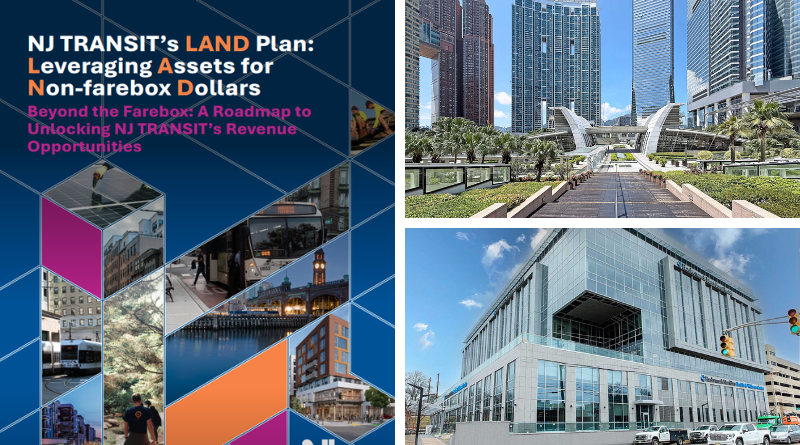
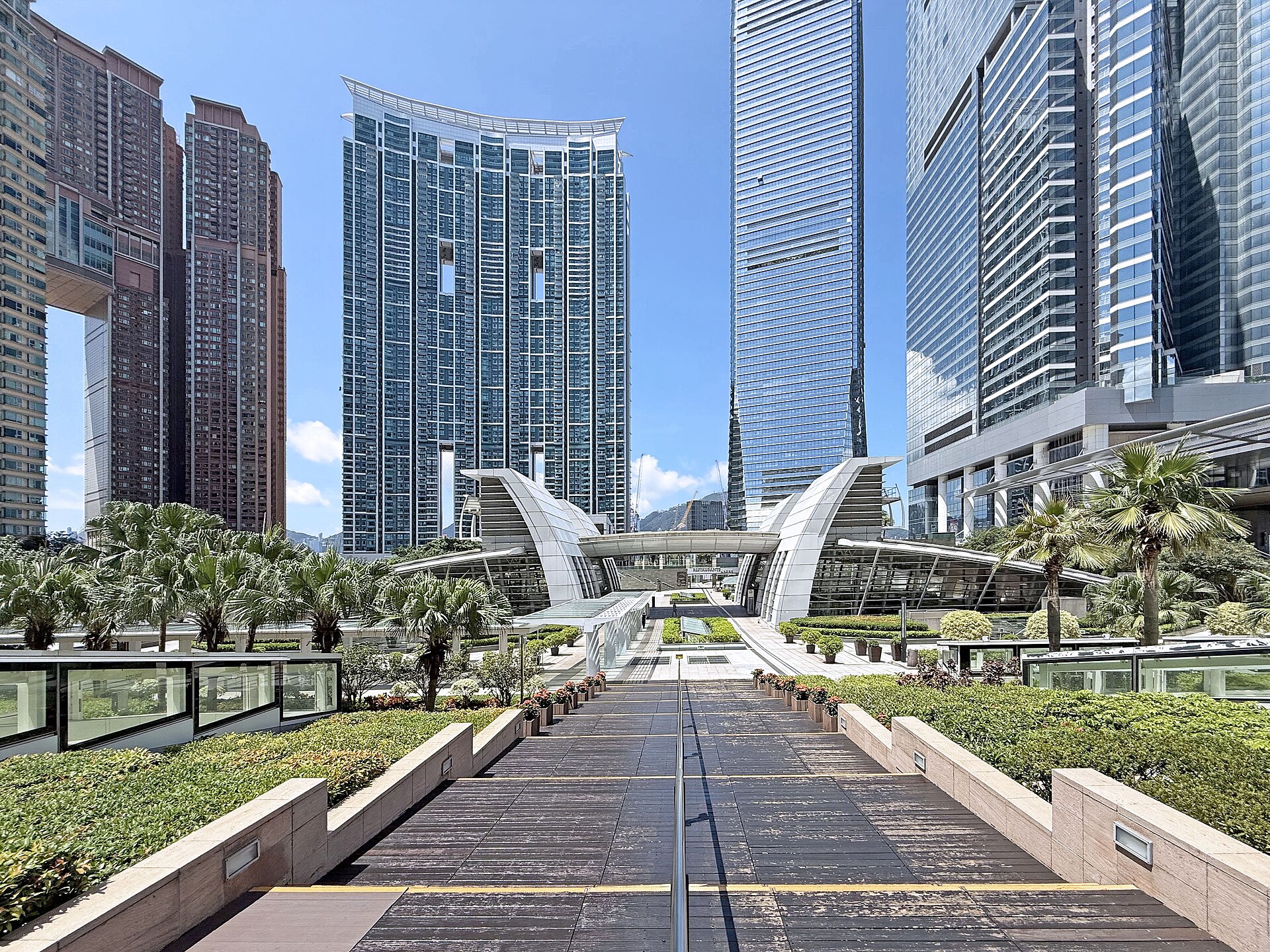
NJ TRANSIT’s LAND Plan (left); Kowloon Station in Hong Kong; Hackensack Meridian Health at Metropark (right top-to-bottom)
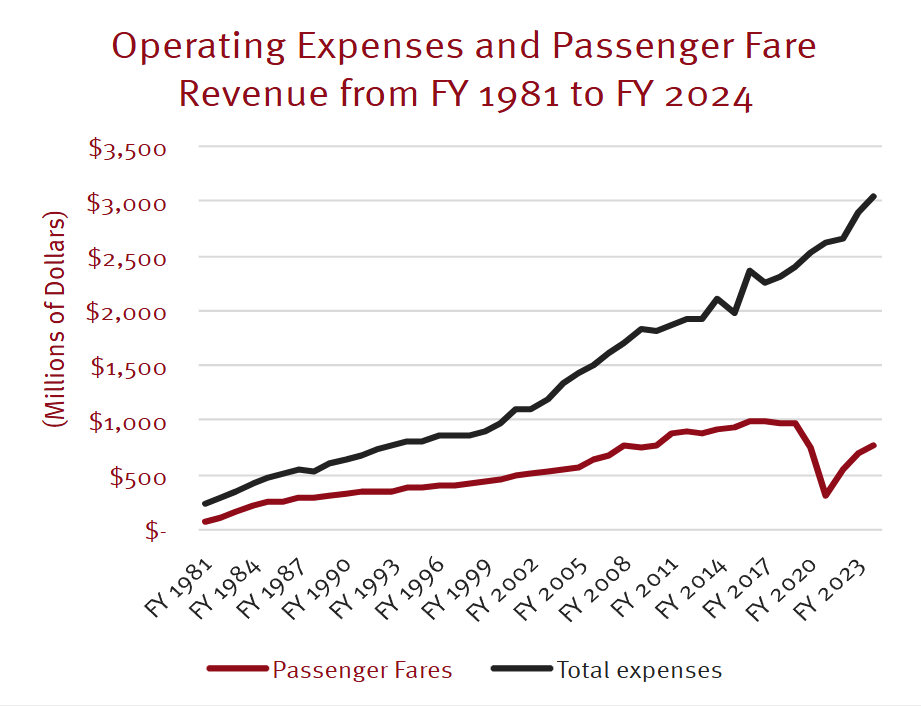
Following the expiration of federal pandemic-era relief, funding for NJ TRANSIT sits on unsteady ground. Before the pandemic, passenger fare revenue covered only a portion of total operating expenses—40 percent in 2019 for NJ TRANSIT—requiring local or state subsidies funded through various taxes and fees that often contain expiration dates.
But shifts following the COVID-19 pandemic—such as declines in ridership, rises in the cost of living, and steady increases in construction costs—have amplified these preexisting transit funding issues. With the annual operating gap for NJ TRANSIT stabilized at over $2 billion, a 66 percent increase from 2019, passenger fares accounted for 24 percent of operating expenses in 2025.
Like other states, New Jersey addressed its funding crisis and implemented an interim solution by enacting a 2.5 percent non-marginal surtax on corporations with a net income over $10 million that established a dedicated revenue stream for NJ TRANSIT. In FY 2026, the corporate transit fee accounted for $789 million of the operating budget, or about 25 percent. The State also increased agency funding through the New Jersey Turnpike Association (NJTA), the Clean Energy Fund, and other general fund expenditures. However, all these sources are discretionary moving forward. Both the corporate transit tax and the NJTA funding contract expire in 2028, requiring renewals through new legislation.
Under the current funding framework, the sustained success of transit service depends on continued support from local and state actors to locate new subsidized funding sources when these taxes and fees expire, sometimes prompting political backlash from transit opponents who frame this funding as bailouts for profligate agencies. Additionally, capital projects are almost entirely financed and funded through federal and state loans and grants, which face similar backlash, especially from residents living farther from the infrastructure improvements.
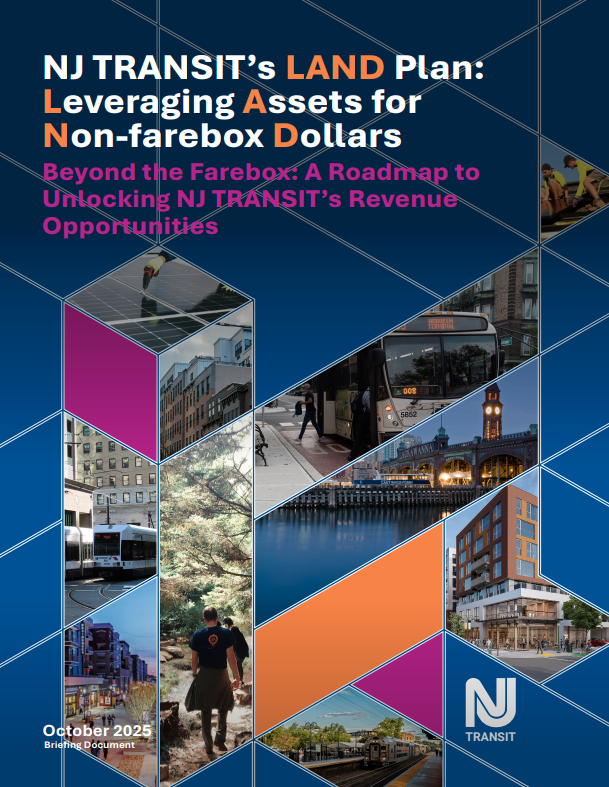
With the release of NJ TRANSIT’s Leveraging Assets for Non-farebox Dollars (LAND) Plan and Governor Sherrill’s Executive Order 17, new initiatives have emerged that seek to restructure the State’s transit funding model through a strategy of Land Value Capture (LVC). The LAND Plan and Executive Order 17 call for development-based value capture, where state departments and transit agencies leverage their underutilized properties to gain new sources of revenue through joint developments. Another strategy of value capture uses Special Improvement Districts (SIDs) and Tax-Increment Financing (TIF) to capture some of the increases in land value generated by transit access.
LVC operates by funding transit through the value it creates rather than alternative state-backed sources. Ideally, this approach reduces political opposition, supports capital and operating budgets, and bridges connections between transit and land use.
What is Value Capture?
Significant prior research has demonstrated that improvements and expansions of transit infrastructure lead to subsequent increases in nearby property values. For example, a study from the Voorhees Transportation Center found that station-area development following the construction of five HBLR stations generated over $5.3 billion in economic growth. However, under the current funding system, many of the direct benefits from these public investments accrue to developers, property owners, and municipalities through increased tax revenue. And since almost all transit services operate under subsidy, expansions put transit agencies in worse financial states, which over time disincentivizes new transit projects. Value capture strategies leverage the relationship between transit and land use to create a win-win-win scenario for:
- Property Owners – who benefit from the increase in property value
- Tenants, Employees, and Business Owners – who gain from the new or improved access to transit
- Transit agencies – who gain from new abilities to improve and expand service
Value capture primarily operates in two forms: development-based and tax-based.
Development-Based Value Capture
Many of the most fiscally successful transit agencies across the world make extensive use of development-based value capture through a Rail + Property (R+P) model. In this model, transit agencies purchase excess land during the construction of new rail infrastructure and work with local governments to gain favorable zoning. Through joint developments with profit-sharing mechanisms, transit agencies leverage synergies between transit and land use to create a positive feedback loop of revenue generation and expansion. The loop operates through these four stages:
- Transit infrastructure improves the value of agency property
- Agency property is developed into mixed-use, medium- to high-density projects
- Agency gains revenue from development and increased ridership
However, this model has mostly only experienced success in Asian countries and cities such as Japan, Hong Kong, China, and Singapore, where supportive zoning, high densities, and alternative land acquisition mechanisms allow real estate revenue to account for between 5 and 42 percent of total operating income. In contrast, joint development typically accounts for 1 percent or less of operating revenue for U.S. transit agencies.
Recent efforts have accelerated across the country to expand the development potential of agency-owned land. In 2025, California passed the Abundant & Affordable Homes Near Transit Act (SB 79), which, beginning July 1, 2026, allows transit agencies to establish their own zoning standards on agency-owned land, enabling higher densities and streamlined approval processes throughout the state. In 2026, Maryland passed the Transit and Housing Opportunity Act, which exempts some WMATA-owned land from local zoning controls, including land use classifications and density restrictions. Other states have adopted legislation to increase density around station areas—such as the Massachusetts’ MBTA Communities Law (2021)—which indirectly enhances opportunities for joint developments.
In 2023, Atlanta adopted an alternative approach to joint development by creating the Atlanta Urban Development Corporation (AUDC), a public corporation that identifies underutilized public land across multiple agencies, departments, and jurisdictions and develops it for new housing. While its primary goal is to increase affordable housing production, similar international examples demonstrate how this model can also support transit investment. Copenhagen financed the construction of its metro system through revenue generated from the development of publicly owned land.
Tax-Based Value Capture
Tax-based value capture strategies aim to directly collect the increases in property values from surrounding properties using fees, taxes, and financing schemes. While this approach may face some backlash due to the inherent aversion to potential tax increases, it offers greater potential revenue generation for capital projects in the U.S., and thus such measures are often voted for in referenda due to the mutual benefits. The two most common tax-based value capture tools used are Tax Increment Financing and Special Improvement Districts.
Tax Increment Financing (TIF) freezes property tax revenues at existing assessment levels and dedicates future growth in tax revenues to infrastructure or redevelopment projects expected to increase in property values. This approach leverages the time value of money by using expected future revenues to finance present-day projects. TIF originated in California during the 1950s as a tool to address blight without relying on citywide general obligation (GO) bonds—which often required voter approval—and quickly expanded across the U.S. for a variety of uses, including transit infrastructure.
TIF payments for infrastructure are usually structured in two ways:
- Debt Servicing: Local governments issue bonds backed by expected increases in revenue, and use capital to finance improvements. If the improvements do not generate property value increases, the public is held liable.
- Pay-As-You-Go: The local government funds improvements incrementally using excess revenues as they are generated. This approach carries less risk but can delay project delivery.

In practice, TIFs have financed numerous transit projects throughout the country. Examples include Hudson Yards in Manhattan, the Red and Purple Lines in Chicago, and the Atlanta Beltline. Well-structured TIF districts, such as those for Chicago’s transit improvements, can retire debt ahead of schedule, while poorly structured districts can create significant fiscal challenges for municipalities. Important factors for structuring TIFs include restricting tax abatements, correctly estimating future revenues, and preventing value destruction in surrounding neighborhoods.
Special Improvement Districts (SIDs) capture value by levying assessments across properties in a designated area near infrastructure improvements. Often, these districts are approved by a referendum of property owners who agree to pay additional taxes in exchange for the expected benefits from the new infrastructure. Property owners within the SID will typically have the option to pay the assessment in one lump sum or divided out across a 20-year period. Similar to TIFs, SIDs often issue bonds derived from expected revenues to finance immediate construction. However, unlike TIFs, these funds are tied to a secure source of new revenue rather than expected increases in property values, resulting in less volatility and lower interest rates.
SIDs are best structured when transit agencies or municipalities minimize exemptions and ensure that the fees are not onerous enough to hurt development. Additionally, the democratic nature of SID approval makes them a good tool for securing federal and state grants. SIDs have been used to fund multiple transit projects, including the Portland Streetcar, the Seattle Streetcar, the DC Metro, and the LA Metro Red Line. It is also important to note that SIDs can only fund infrastructure within the parameters of the district, meaning the funds cannot be used for transit vehicles.
Implications for New Jersey
These strategies are not one-size-fits-all approaches and often rely on multiple factors, including the existing built environment, supportive legislation, resident approval, and active collaboration between various stakeholders. New Jersey’s unique situation diminishes the potential use of some value capture strategies, while enabling other strategies to thrive.
Special Improvement Districts in New Jersey

New Jersey sanctioned the ability for municipalities to create Special Improvement Districts through the New Jersey Pedestrian Mall and Special Improvement District Act of 1984. The Act grants SIDs the right to levy special assessments on properties located within the district to fund local improvements and promote commercial activity. Municipalities can create SIDs through a local ordinance, usually following preliminary studies and community outreach to gauge public support, draw the specific lots within a district, forecast potential revenue, and develop the goals of the SID. Either in the initial ordinance or at any point afterwards, the municipality can designate a District Management Corporation (DMC) to administer the district. Unlike many states, municipalities do not need to hold a vote on enacting a SID in New Jersey. In practice, these SIDs function as homeowners’ associations for downtowns, facilitating landscaping, trash pickups, special events, and minor streetscape improvements. In New Jersey, a SID has never been used to fund a transit improvement project.
However, the legislation does not prohibit a SID from being used to fund transit. Instead, the statute provides broad and flexible authority regarding SID powers. The required justifications for forming SIDs only include that it would benefit local property owners and residents, boost commercial activity, require a special assessment to support the improvement, and be in the best interest of the municipality. Large-scale transit improvement and extension projects could cover all these bases. Research shows that past NJ TRANSIT projects have increased property values, boosted municipal tax revenue, and catalyzed commercial activity.
Forming a SID requires appointing either an advisory board or a District Management Corporation. The legislation states that an advisory board must contain a property owner majority, and that, upon designation, a District Management Corporation exercises the functions of the advisory board. The New Jersey Department of Community Affairs (NJDCA) interprets this legislation as requiring a property owner majority for the District Management Corporation board, but the legislation does not explicitly impose those constraints.
Under a more textual interpretation of the New Jersey Statutes, NJ TRANSIT could partner with municipalities to form SIDs and District Management Corporations, administered by the transit agency. The District Management Corporation has the legal rights to purchase, sell, lease, and repair properties, take on public or private debt, employ workers, receive grants and donations, execute legal agreements, levy assessments on properties, and tax profits from local businesses.
Other legislation allows for the creation of similar entities, such as the Transportation Development District Act of 1989. Transportation Development Districts (TDDs) are an underutilized tool in New Jersey, which enables counties to raise revenue for transportation infrastructure projects in areas facing high rates of new growth. While transit projects could qualify for a TDD, multiple mechanisms in the legislation limit the potential feasibility:
- TDDs can only raise revenue through impact fees, which are taxes applied to new developments. Impact fees can discourage new development and limit value-capture potential.
- TDDs must be managed by NJDOT in partnership with county governments. A transit infrastructure project would require collaboration between NJDOT, a county, NJ TRANSIT, and municipalities, with NJDOT as the lead.
- TDDs require meeting stringent growth-based measures, including 20 percent population growth over a 10-year period, traffic growth of 50 percent over a 5-year period, or one million square feet of commercial growth per square mile.
Tax Increment Financing in New Jersey
While New Jersey municipalities could previously use TIF through the Economic Redevelopment and Growth Grant (ERGG) program and the Revenue Allocation District Financing Act (RADFA), the State no longer enables the use of this tool. Legislators prohibited the creation of Revenue Allocation Districts in 2009 and replaced the ERGG with Aspire—a tax credit program run by NJEDA in 2020. Multiple factors were at play with the retirement of TIF-enabling legislation, but the main one was underuse. Complexity, low need, and the heavy use of alternative mechanisms like PILOTs offset the demand for TIFs.
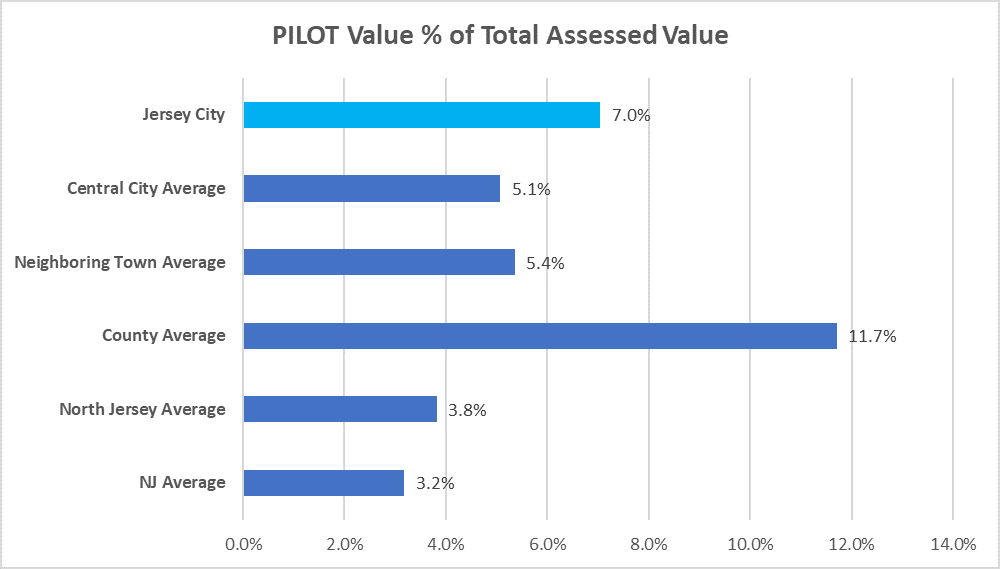
Using TIF as a value capture mechanism for transit infrastructure projects would require New Jersey lawmakers to pass new legislation enabling its use. However, the factors that limited the success of TIFs in the past still remain, diminishing the tool’s potential for NJ TRANSIT.
TIF is most popular in large, sprawling cities on the West Coast and the Midwest because it allows municipalities to bypass citywide votes and governance in favor of more targeted investment. But due to boroughitis, New Jersey municipalities are already very small. Freezing tax revenues across just a square mile could cover large portions of many northern Jersey cities.
Furthermore, TIF only applies to taxable properties, which excludes developments with PILOT agreements. As the use of PILOTs continues to rise throughout the state, the potential revenue capture from TIFs will continue to decline. Lastly, many municipalities—such as Jersey City—already face large fiscal constraints, making offsetting future revenues politically infeasible.
Joint Development in New Jersey
Under NJ TRANSIT’s enabling statute, the transit agency is allowed to purchase, acquire, lease, and sell real estate. In the 1980s and 1990s, NJ TRANSIT primarily used this authority to develop, maintain, and generate revenue from station-area parking lots. But initiatives like transit friendly planning and smart growth led NJ TRANSIT to rethink how the agency utilizes its properties. In the 1990s, NJ TRANSIT and Morristown partnered to develop Sofi at Morristown Station, a mixed-use development on a former parking lot.
Since then, NJ TRANSIT has advanced numerous joint developments and released plans outlining strategies for leveraging its real estate portfolio. In 2024, NJ TRANSIT released a TOD Policy Statement—which outlined goals and procedures for NJ TRANSIT-backed projects—such as requiring 20 percent affordable units, paying prevailing wages, prioritizing disadvantaged businesses, and prioritizing unsubordinated ground leases.
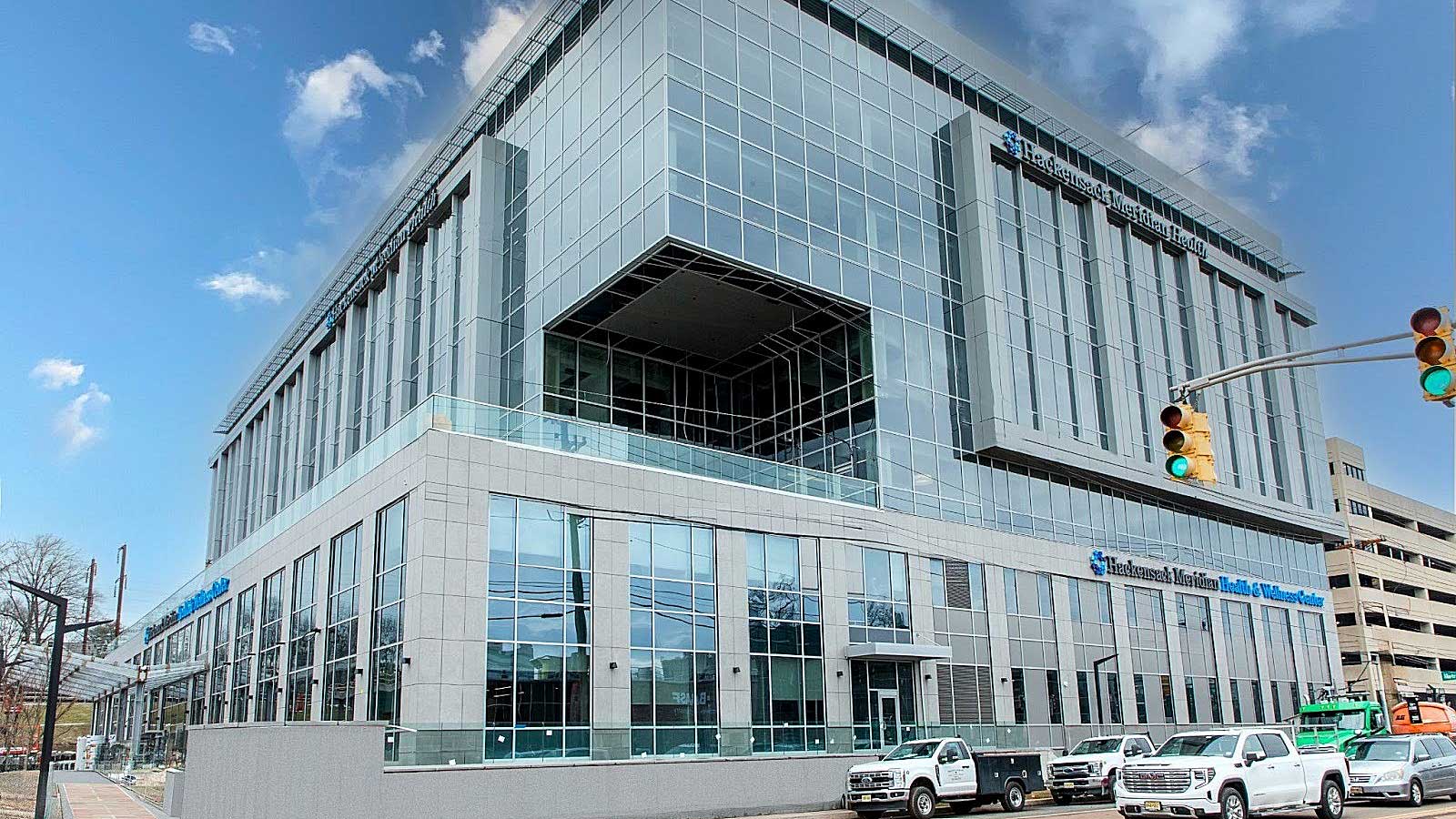
More recently, the transit agency released its LAND Plan, which identified the potential for up to $1.9 billion in additional revenue, $14 billion in economic impact, 20,000 new housing units, and 50,000 jobs created. Two major examples of ongoing NJ TRANSIT joint developments are Hoboken Connect and Metropark. NJ TRANSIT has partnered with the City of Hoboken and LCOR to revitalize underutilized lots near the Hoboken Terminal, with initial plans to develop 704,000 sq. ft. of office space, two acres of open space, 70,000 sq. ft. of retail, and 386 residential units. However, these plans are currently under review to replace some of the office space with additional residential units. At Metropark, NJ TRANSIT worked with multiple private developers to deliver a mixed-use development with 230 units, ground-floor retail, and healthcare space—including primary care, on-site imaging, phlebotomy lab, rehabilitation, urgent care, and a pharmacy—for Hackensack Meridian Health on a former NJ TRANSIT parking lot.
Following these successes, there are additional opportunities for NJ TRANSIT to expand its development program. New Jersey could pass legislation to streamline new developments in station areas using Maryland or California as examples. This could either operate through general station-area upzonings such as in California’s SB 79 or targeted legislation that grants NJ TRANSIT greater zoning control over its properties. Other opportunities include unbundling parking, working with other state agencies, counties, and municipalities to develop their transit-adjacent properties, or directly developing future projects.
Final Thoughts
As NJ TRANSIT continues to face fiscal uncertainty, value capture provides a mechanism by which the agency can financially benefit from its own services rather than fully rely on uncertain state subsidy. Value capture functions in two forms: tax-based and development-based. Both types serve as tools that could help boost NJ TRANSIT’s financial situation, but in different ways.
Development-based value capture—such as the approach advanced in NJ TRANSIT’s LAND Plan—could help close part of the operating gap that widened following the COVID pandemic. While tax-based value capture, like Special Improvement Districts, could help partially fund and finance new transit infrastructure projects, allowing the agency to advance improvements and expansions on its own timeline.
Sources
Bond, M., & DiPetrillo, S. 2025. From challenge to resilience: The evolution of NJ TRANSIT funding and a roadmap to a reliable future. Alan M. Voorhees Transportation Center, Edward J. Bloustein School of Planning and Public Policy, Rutgers, The State University of New Jersey. https://vtc.rutgers.edu/wp-content/uploads/2026/01/NJT-Funding-Report_VTC-2025-FINAL.pdf
Briffault, Richard. 2010. The Most Popular Tool: Tax Increment Financing and the Political Economy of Local Government. The University of Chicago Law Review. 77. 65-95. 10.2307/40663026.
Ceder, A. 2016. Public Transit Planning and Operation: Modelling, Practice and Behaviour. CRC Press, Boca Raton, USA.
Fike, B. J., & McAdams, B. 2025. Case Study: Formation of the Atlanta Urban Development Corporation (, Ill.). Nowak Metro Finance Lab, Drexel University. https://doi.org/10.17918/00011105
Fisher, Bridget, Flávia Leite, and Rachel Weber. 2023. “Value Creation, Capture, and Destruction: Hudson Yards and the False Promise of Self-Financing Mega-Projects.” Journal of the American Planning Association 89 (1): 134–45. https://doi.org/10.1080/01944363.2022.2026808.
Haider, Murtaza, and Liam Donaldson. 2016. Can Tax Increment Financing Support Transportation Infrastructure Investment? IMFG Papers on Municipal Finance and Governance 2016, no. 25. Institute on Municipal Finance & Governance.
Haller, Olivia. 2025. Hoboken Connect: Revitalizing Hoboken Terminal. Regional Plan Association
Housing Development: Transit-Oriented Development, Cal. S.B. 79 (2025-2026), Chapter 512 (Cal. Stat. 2025). https://leginfo.legislature.ca.gov/faces/billTextClient.xhtml?bill_id=202520260SB79
Hovy et. al, “Value Capture Implementation Manual: Capitalizing on the Value Created by Transportation”, Federal Highway Administration, 2019.
Justice, J. B., & Goldsmith, R. S. 2006. Private Governments or Public Policy Tools? The Law and Public Policy of New Jersey’s Special Improvement Districts. International Journal of Public Administration, 29(1–3), 107–136. https://doi.org/10.1080/01900690500409005
Katz, B., & Noring, L. (2017). The Copenhagen City and Port Development Corporation: A Model for Regenerating Cities. The Brookings Institution. City Solution No. 1 https://www.brookings.edu/wp-content/uploads/2017/05/csi_20170601_copenhagen_port_paper.pdf
Korngold, G. 2022. Land Value Capture in the United States: Funding Infrastructure and Local Government Services. Lincoln Institute of Land Policy.
Mathur, Shishir. 2014. “Special Assessment District’s Ability to Fund Transit: Lessons from Project-Level Analysis.” Transportation Research Record: Journal of the Transportation Research Board 2417 (1): 103–10. https://doi.org/10.3141/2417-11.
Mathur, Shishir, and Aaron Gatdula. 2021. “Addressing Barriers to the Use of Value Capture to Fund Transit-Oriented Developments.” Case Studies on Transport Policy 9 (2): 511–27. https://doi.org/10.1016/j.cstp.2021.02.007.
National Academies of Sciences, Engineering, and Medicine. 2020. Tax Increment Financing for Transit Projects. Washington, DC: The National Academies Press.
New Jersey, P.L. 2024, c.20, codified at N.J. Stat. § 54:10A-5.41a; State of New Jersey, Budget in Brief: Fiscal Year 2026, discussing the Corporate Transit Fee as a dedicated funding source created as pandemic-era federal funding was depleted.
NJ TRANSIT. 2025. NJ TRANSIT Adopts Fiscal Year 2026 Operating and Local Programs Budget, Secures Authorization for Capital Funding.
NJ TRANSIT. Transit-Oriented Development Policy Statement. 2024.
NJ TRANSIT. 2025. “NJ TRANSIT’s LAND Plan: Leveraging Assets for Non-farebox Dollars.” https://content.njtransit.com/sites/default/files/marketing/website/pdf/REAL_ESTATE_OPPORTUNITY_REPORT.pdf
Redevelopment Area Bond Financing Law, N.J. Stat. Ann. § 40A:12A-64 et seq. (2026).