
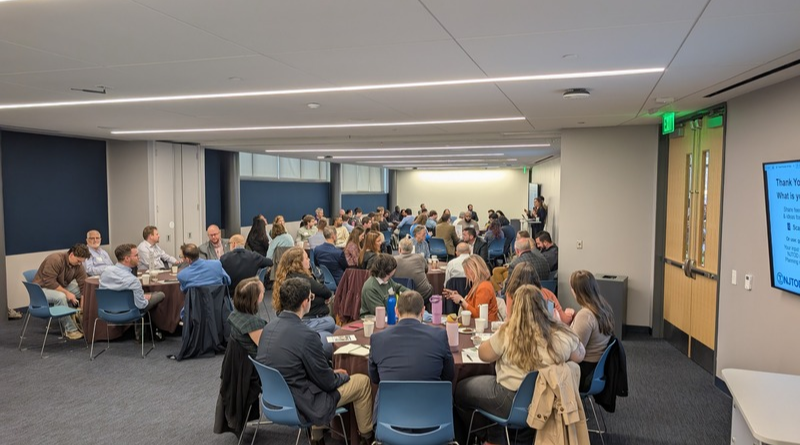
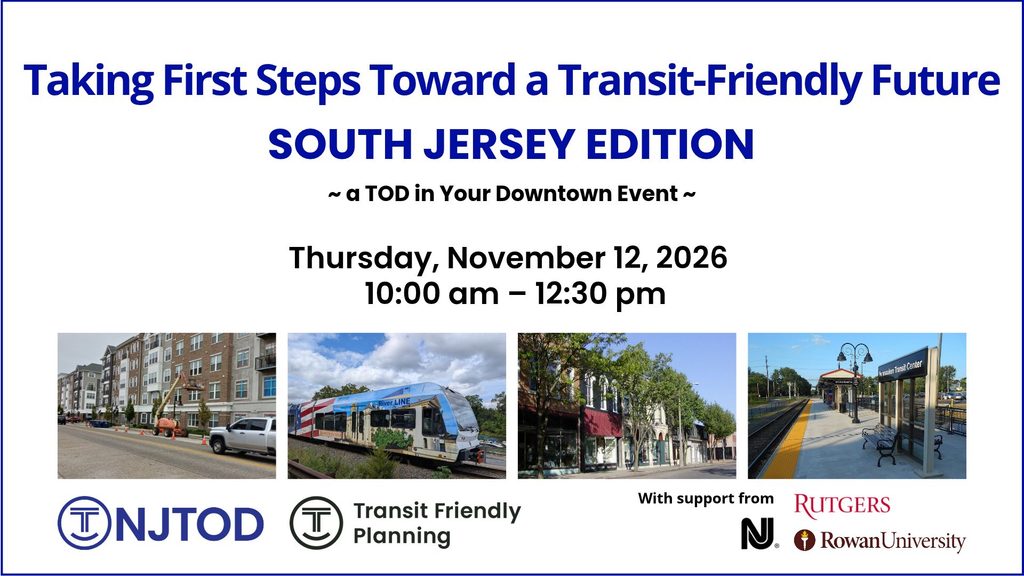
Municipal officials, planners, students, and transit professionals gathered at Rowan University on November 12 to discuss strategies for building a transit-friendly future in South Jersey. The event—Taking First Steps Toward a Transit Friendly Future: South Jersey Edition, hosted by NJTOD, NJ TRANSIT’s Transit Friendly Planning program, and Rowan University—followed the success of the first iteration of the event, held in June at NJ TRANSIT’s Headquarters. NJTOD brought the event to Rowan University to give South Jersey stakeholders a chance to hear from representatives of various state agencies. Attendees asked questions across a wide range of topics, including Governor Sherrill’s new housing plan, potential opportunities with the proposed Glassboro-Camden Light Rail Line (GCL), and how smaller municipalities can access and benefit from statewide grant programs.
The event began with an overview of transit friendly planning from Stephanie DiPetrillo, Principal Investigator of NJTOD at the Voorhees Transportation Center (VTC), followed by brief presentations from representatives of each state agency, as well as Downtown New Jersey. After the presentations, the experts joined attendees at tables and discussed a range of topics during eight ten-minute small group discussions. The event program can be found here.
Introduction
Stephanie DiPetrillo began by defining transit-friendly planning.
Like concepts such as 15-minute cities and smart growth, transit friendly planning seeks to cluster housing, jobs, shops, and transit. Many older New Jersey towns already follow this model, as this historic development pattern is now recognized for its ability to expand housing supply, strengthen downtowns, attract investment, and preserve open space. It also works across a wide range of communities—from bus-oriented development in Old Bridge to regional destinations like Somerville, and urban areas like Camden.
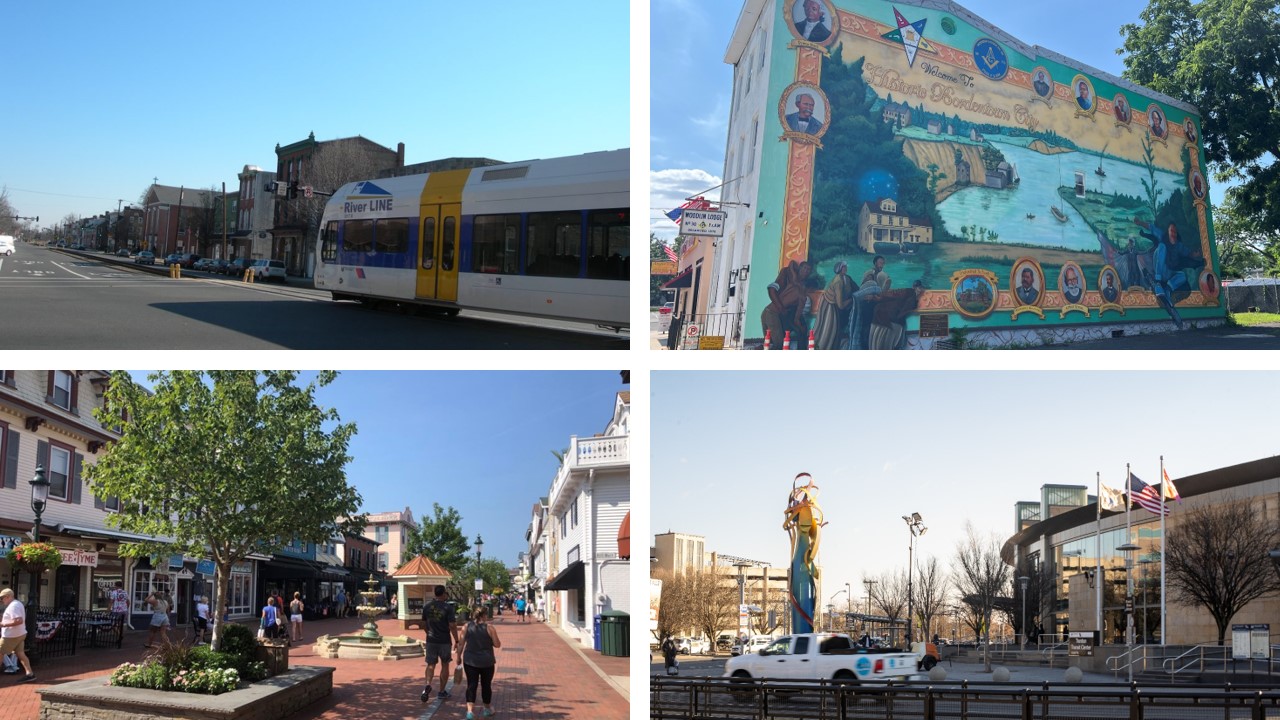
For more, see NJTOD’s Transit Friendly 101: Back to Basics.
The experts then outlined how their agencies and organizations support transit-friendly planning:
Lisa Avichal (Senior Planner, NJ Office of Planning Advocacy) explained how the 2025 New Jersey State Development and Redevelopment Plan promotes planning for mixed-use development and highlighted technical assistance available to municipalities.
Michael Manzella (Director of Statewide Planning, NJ Department of Transportation) highlighted the Transit Village Initiative, which provides millions of dollars in annual grant funding for station-area infrastructure improvements across the 37 designated Transit Villages. The program is actively looking for more South Jersey municipalities to seek designation.
Megan Massey (Director of Transit Friendly Planning, NJ TRANSIT) provided an overview of the technical assistance conducted by Transit Friendly Planning at NJ TRANSIT. She also highlighted NJ TRANSIT’s Leveraging Assets for Non-farebox Dollars (LAND) Plan to leverage the transit agency’s real estate portfolio for station-area development.
Jonathan Sternesky (Director of Policy and Internal Affairs, NJ Housing & Mortgage Finance Agency) delivered a short introduction to the mission of the NJHMFA and Low Income Housing Tax Credits (LIHTC).
Kathy Guzman (Senior Small Business Liaison, NJ Economic Development Authority) outlined grant opportunities that can support transit friendly planning efforts for local businesses and organizations.
Simran Riar (Senior Planner, NJ Department of Community Affairs) presented the types of assistance provided by the Division of Local Planning Services at NJDCA, including the administration of the Main Street New Jersey program.
Elise Bremer-Nei (Bicycle and Pedestrian Program Coordinator, NJ Department of Transportation) highlighted the active transportation grant and technical assistance programs managed by NJDOT.
Natalie Pineiro (Executive Director, Downtown New Jersey) provided an overview of the mission of Downtown Jersey to support strong downtowns through education, advocacy, and recognition. She also highlighted upcoming Downtown New Jersey events.
Small Group Discussions
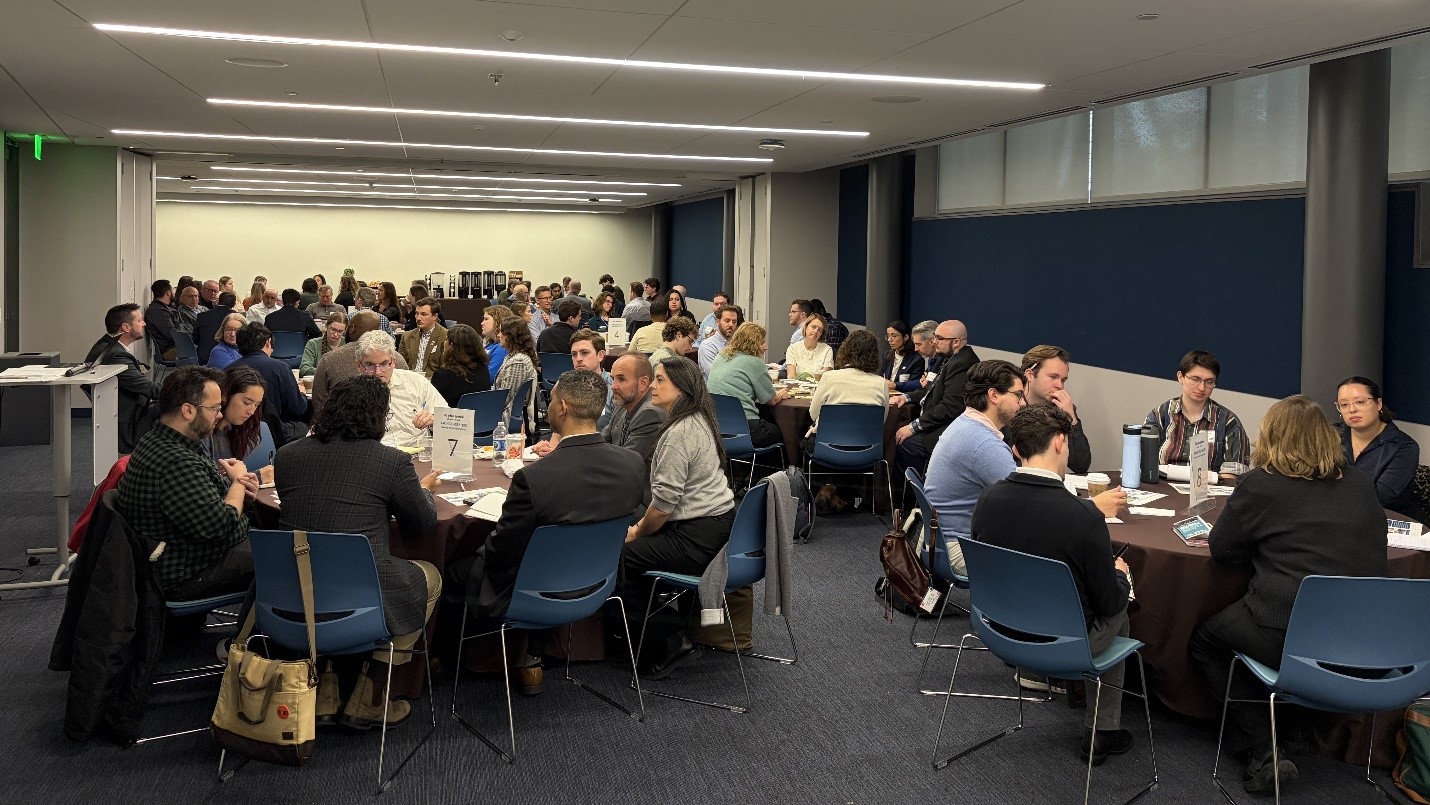
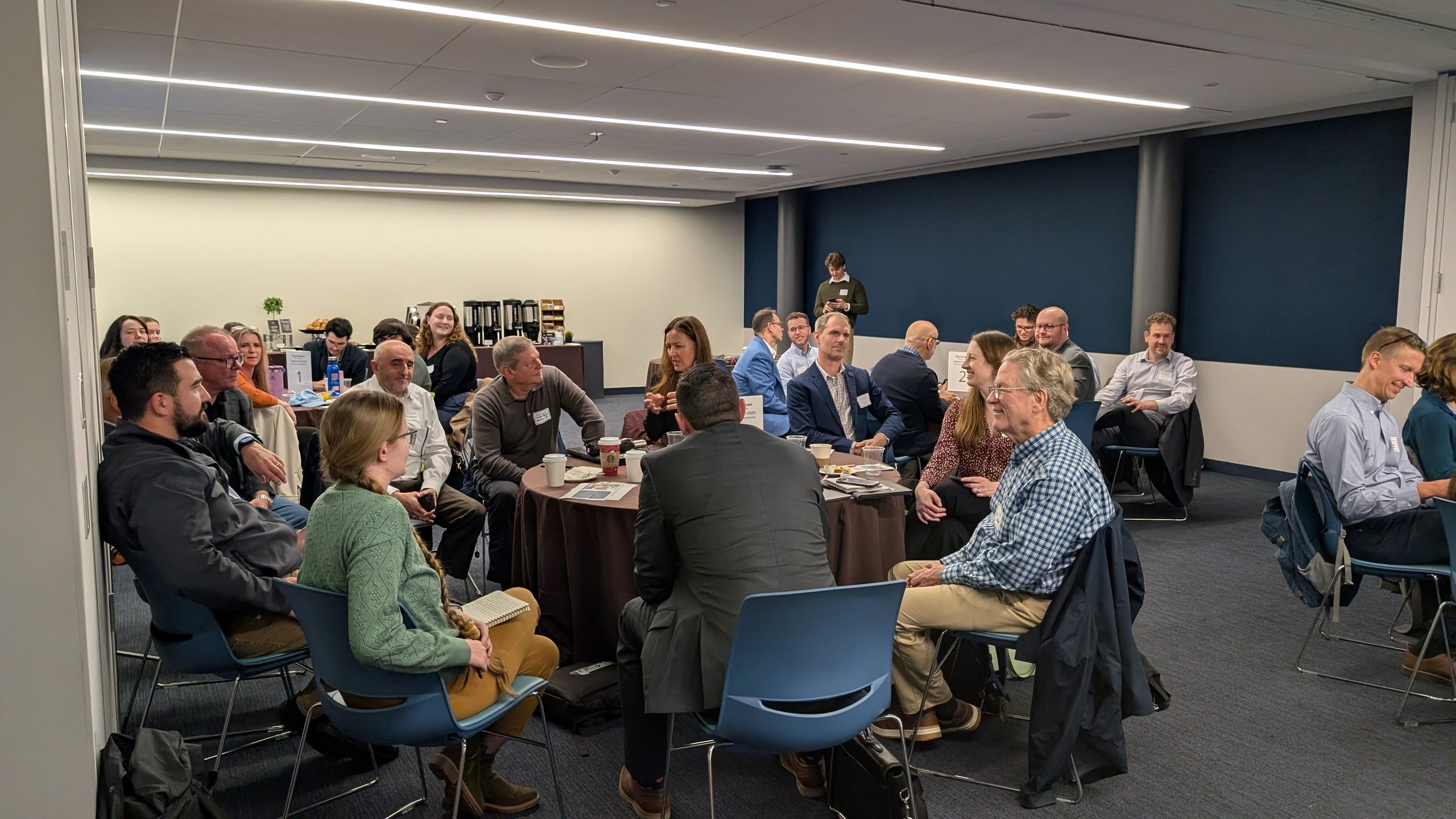
After the presentations, experts joined attendees at tables for rotating small group discussions. The discussions lasted for ten minutes, after which the experts rotated to new tables, giving attendees multiple opportunities to ask questions and engage with presenters. Note takers at each table recorded key takeaways. A special thanks to the Rowan University students—Courtney Scott, Ciara Mulligan, Gabrielle McCutchan, Ethan Theurer, Odnier Rivera, and Nick Source—who helped with the note taking.
State Plan and Collaboration
Lisa Avichal talked to attendees about the 2025 New Jersey State Development and Redevelopment Plan (a transit-friendly review of the plan can be found here) and the importance of cross-agency collaboration. The goal of the State Plan is to guide statewide development through incentives, including through Municipal Plan Endorsement where municipalities can receive priority funding for state grants if they comply with the State Plan.
In previous iterations of the State Plan, plan endorsement could be an onerous process. One attendee noted that the resources used for plan endorsement far exceeded the benefits of endorsement. Ms. Avichal noted that there have been efforts made to simplify the process for the 2025 State Plan. Throughout the discussion, she highlighted how NJOPA serves as a connector between all of the state agencies.
Transit Village Initiative
Michael Manzella talked to attendees about the Transit Village Initiative, which provides designated municipalities with the potential to access a grant fund pool for pedestrian and bicycle improvements, and placemaking opportunities. Some South Jersey municipalities participate in the program, including Atlantic City, Pleasantville, Collingswood, Burlington, and Riverside. The Transit Village Initiative also encourages municipalities that may receive GCL service to apply.
Transit Friendly Planning
Megan Massey and Michael Swan answered questions from municipal stakeholders on the services provided by Transit Friendly Planning and the potential for TOD within their communities. Municipal officials expressed interest in receiving technical assistance to support existing transit facilities and plan for future transit-oriented development opportunities, especially for bus terminals and potential GCL station areas. Some attendees noted that public education and community engagement about the potential benefits of the GCL could help raise awareness and support for the project.
Tax Credits and Affordable Housing
Jonathan Sternesky underscored the importance of tax credits in bridging the gap for developers to build affordable housing. NJHMFA primarily works with developers, but relies on municipalities to pass a resolution of need in order to grant LIHTCs. Projects that want to access LIHTCs are graded according to discretionary criteria, which includes proximity to community resources, transit access, and potential additional services offered at the development. These tax credits are also only available for multifamily housing since affordable housing makes the most financial sense in large-scale projects, especially as construction costs and loan rates continue to rise.
Aspire Tax Credits
Kathy Guzman spoke on the programs offered by NJEDA to support development and small businesses, including Aspire. Aspire is a tax credit program that aims to help developers close financing gaps in support of new housing and revitalization. Ms. Guzman noted that small businesses often struggle with the application process for Aspire and bond financing, but NJEDA can provide support throughout the process.
Local Planning Services
Simran Riar discussed the work of the Division of Local Planning Services at NJDCA. Attendees asked numerous questions regarding strategies for community revitalization and the role of Local Planning Services. One attendee questioned how Local Planning Services can support municipalities without a traditional downtown. Mr. Riar responded that municipalities could rezone commercial areas to create connected corridors, develop mini downtowns, and support new housing development. Another attendee asked how DCA can support community engagement. For approved projects, NJDCA can help put together online surveys and public meetings.
Active Transportation
Elise Bremer-Nei answered questions about bicycle and pedestrian assistance at NJDOT, including the Bicycle Pedestrian Resource Center and Safe Routes to School, both supported by the Voorhees Transportation Center (VTC) at Rutgers University. She highlighted the various grant programs available to municipalities, stating that the application process for these grants is easy and that hundreds of projects are advanced annually.
In addition to VTC, NJDOT also works with the eight Transportation Management Associations (TMAs) that operate throughout New Jersey to advance active transportation goals. The partnership between the three organizations provides education, training, and public outreach for pedestrian and bicyclist safety.
Strategies for Downtown Revitalization
Natalie Pineiro spoke on the importance of partnerships and collaboration in building strong downtowns, referring both to the close relationship that Downtown New Jersey has with municipalities, but also to the vital role that Special Improvement Districts (SIDs) play in downtown revitalization. SIDs are often managed by local business owners who collaborate to host events, advance downtown beautification, and seek to drive investment into downtowns.
She also emphasized that a “one size fits all” approach does not work when trying to create strong downtowns. Each community is different and requires specifically tailored solutions. Through education, municipalities can identify what has worked in other areas and what might work for them. Some potential approaches include adjusting parking pricing to encourage alternative transportation modes and quicker turnover, creating action plans with widespread community involvement, and preparing inventories of community assets.
Final Thoughts
While North Jersey often receives more attention for public transportation and transit-oriented development, the more than 70 stakeholders, community members, and public officials who attended this event demonstrated strong interest in transit friendly planning practices in South Jersey. By engaging directly with state agencies and planning experts, attendees gained practical tools and resources to help advance smart growth goals in their communities.