
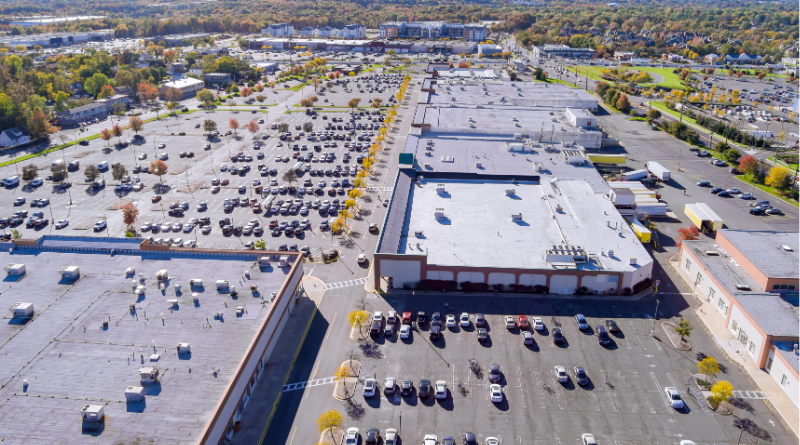
Aerial view of parking in New Jersey. Ungvar | Adobe Stock
In The High Cost of Free Parking, Donald Shoup made the case that free parking is not actually free. Instead, businesses, property owners, and municipalities incorporate the cost of parking into the price of goods, rents, and taxes. When an employer offers free parking, the cost comes out of your salary. When an apartment offers free parking, the cost comes out of your rent.
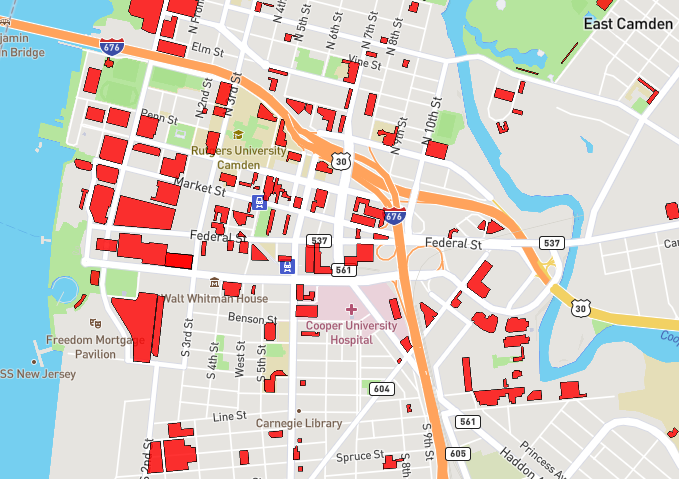
Bundling parking with other costs also obscures the relationship between supply and demand. When drivers do not pay directly for parking, they have less incentive to consider its cost when deciding whether and where to drive. At the same time, municipalities and developers may interpret high demand for free parking as justification for providing more of it. In American cities with more than 1 million people, 22 percent of central business district (CBD) land is dedicated to parking lots.
Free parking also makes the costs of car ownership compulsory. Households that choose to live in a transit-friendly, walkable neighborhood to reduce transportation costs may still pay for parking through higher rents and taxes, even if they do not own a car. These costs affect the one-third of Americans, or approximately 100 million people, who do not drive. For households that do own cars, paying indirectly for parking can make car ownership seem less expensive than it actually is.
New Jersey illustrates the issue. A 2023 report from the Rutgers Center for Real Estate (RCRE) found that the state’s Residential Site Improvement Standards (RSIS) require an average of 0.5 more parking spaces per rental housing unit than needed. At an average cost of $27,900 per parking space, this requirement increases construction costs by $13,950 per unit and rents by $80 per month. Structured parking is even more expensive, driving up costs in urban areas. In major U.S. cities, aboveground structured parking averages $52,000 per space while underground averages $73,000 per space, according to the UCLA Institute of Transportation Studies.
As housing and transportation affordability remain major issues in New Jersey and throughout the United States, separating the costs of parking from the cost of housing offers one potential way to reduce the cost borne by households that do not need parking. This approach, known as unbundled parking, also makes the cost of parking more transparent and gives residents a choice about whether to pay for it.
Unbundled Parking
Unbundled parking refers to leasing or selling parking spaces separately from a residential unit, rather than including cost of parking in rent or the purchase price. Residents who need parking can choose to pay for it, while those who do not use parking are not required to bear its cost.
Unbundling addresses a different issue from parking requirements. Parking requirements determine how much parking a development must provide; unbundling determines how the cost of that parking is allocated. A development can provide substantial parking while charging residents separately for it. Conversely, a development can have reduced or no parking requirements without unbundling the parking it does provide.
Multiple research studies have examined the relationship between bundled parking, parking costs, and vehicle ownership.
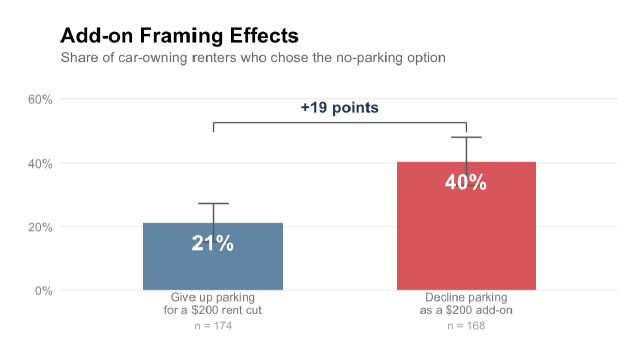
In Los Angeles, a survey experiment of 387 renters found that bundled parking listings increase the stated likelihood of future car ownership among car-free renters. The study also found that when parking costs were presented as an add-on to rent rather than included in the overall price, a significant number of car owners opted out of paying for parking. This illustrates the role of cost salience in consumer behavior: when the cost of an item is incorporated into the larger purchase, consumers may be more likely to pay for something they would not have purchased separately.
A similar survey of 442 apartment renters in Melbourne, Australia, found that about 35 percent of renters experienced a mismatch between the supply and demand for bundled parking at their apartment complexes. The study also found that 42 percent of renters surveyed were receptive to unbundling parking.
A 2017 study of renters using American Housing Survey data and hedonic regression techniques found that the cost of garage parking to renters was $1,700 per year, or 17 percent of total rent. The study estimated that car-free renters paid around $440 million annually for unused parking.
Another study using American Housing Survey data found that households with bundled parking were 50 to 75 percent less likely to be car-free than households without bundled parking. The study also found that cities with required parking at residential developments had higher rates of car ownership and use.
Taken together, the research suggests that bundling parking with housing can affect both housing costs and decisions about car ownership. Unbundling makes the cost of parking more visible and gives residents who do not need parking an opportunity to avoid paying for it.
As a whole, unbundled parking can:
- Make housing and parking costs more transparent.
- Allow households that do not use parking to avoid paying for it.
- Give residents greater choice about whether to pay for parking.
- Potentially reduce parking demand by making its cost more visible.
- Support greater use of transit, walking, and cycling.
- Allow more efficient use of land near transit stations, where developable land is especially valuable.
Applications in New Jersey
New Jersey faces many of the same parking and affordability challenges. The Department of Community Affairs (DCA) estimates that the state needs 84,698 new affordable homes over the next decade. Beyond specifically subsidized affordable housing, there is a need to make all homes in New Jersey more affordable. The 2024 American Community Survey found that 52.2 percent of New Jersey renter households are cost-burdened, meaning they pay more than 30 percent of their income on rent.
The state’s parking requirements are one part of this affordability discussion. The 2023 RCRE report cited above found that New Jersey’s RSIS requires more parking than rental housing needs on average. Reducing or eliminating parking requirements can give developers more flexibility in determining how much parking to provide, particularly near transit. This increases available square footage and construction budget for additional housing units, lowers costs to renters, and makes more income-restricted units possible.
New Jersey has taken some steps in this direction. A bill, S3605, passed the Senate in 2023 with the aim of reducing parking minimums near transit facilities statewide. Although the bill was not signed into law, similar bills have been proposed in the current legislative session. Individual municipalities have also removed parking requirements near public transit, including Newark through the Broad Street Redevelopment Zone and Jersey City through multiple redevelopment plans.
Reducing parking requirements and unbundling parking, however, are separate strategies. New Jersey does not require residential developments to bundle parking costs into rents or purchase prices. A development can meet its parking requirements while charging residents separately for parking. In other words, unbundling is already permitted under the state’s existing framework. In fact, NJ TRANSIT’s Transit Oriented Development (TOD) policy explicitly requires its development partners to plan for unbundled parking in station areas.
New Jersey Examples of Unbundled Parking
Listed below are examples of residential developments in New Jersey with unbundled parking, and the cost per parking space:
Click to view table.
| County | Development | Address | Parking Information |
| Atlantic | 600 NoBe | 600 No. Bedford Ave, Atlantic City | $100/month per vehicle for assigned garage parking; no complimentary surface options available on-site. |
| Bergen | Ridgetop Leonia Manor Apartment Building | 425 Broad Ave Apt 405, Leonia | $125/month for garage parking and $75/month for assigned outdoor parking. |
| Bergen | The Jefferson | 2 Kinderkamack Rd, Hackensack | 1st spot – $100 | 2nd spot – $75 | 3rd spot – $200 (Garage Lot). |
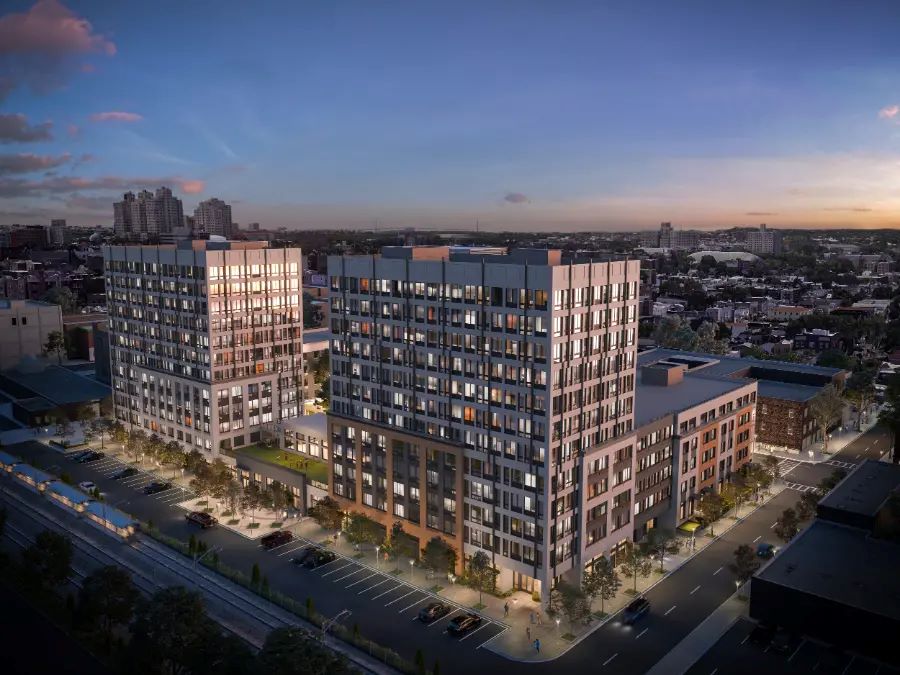
| Camden | 11 Cooper | 11 Cooper St, Camden | Free/First-come first-served exterior options are unavailable; residents pay $150 to $200/month per vehicle for assigned parking spaces inside the secure, attached parking garage structure. |
| Essex | Claremont Holdings | 188 Claremont Ave, Montclair | $80/month per vehicle for covered lot parking and $70/month per vehicle for surface lot parking. |
| Essex | The Montclarion Apartments | 10 Pine St, Montclair | $50/month per vehicle (Max of 1) for surface lot parking. |
| Essex | Parkway Lofts | 5 Lawrence St, Bloomfield | $150/month per vehicle for garage parking lot. |
| Hudson | The Harper at Harmon Meadow | 100 Park Plaza Dr, Secaucus | $125/month per vehicle (Max of 3) for assigned surface lot or covered parking. |
| Hudson | 221 Bergen | 221 Bergen St, Harrison | $200/month per vehicle (Max of 1) for garage parking lot. |
| Hudson | Hamilton Cove | 800 Harbor Blvd, Weehawken | $250/month per vehicle for covered lot parking and $350/month per vehicle for tandem parking (verified directly). |
| Hudson | West Side Square | 1075 West Side Ave, Jersey City | $275/month per vehicle (Max of 1) for garage parking lot. |
| Mercer | Avalon Princeton | 100 Witherspoon St, Princeton | Parking is fully decoupled. Spaces in the controlled-access underground parking garage cost $175 to $225/month per vehicle (pricing tiers vary based on EV-charging capability). |
| Mercer | Palmer Square Apartments | 4 Palmer Square East, Princeton | On-site parking is not included in base leases. Residents must obtain an unbundled monthly parking contract through the Palmer Square garages starting at roughly $190/month per vehicle. |
| Middlesex | Station Bay | 1000 Schindler Dr, South Amboy | $100 to $125/month per vehicle for garage parking and $75/month per vehicle for surface lot parking. |
| Middlesex | Legacy Place | 1 Legacy Pl, East Brunswick | $150/month per vehicle (Max of 1) for surface lot parking. |
| Middlesex | Quincy Heights – Woodbridge Township | 175 Quincy Ct, Perth Amboy | $100/month per vehicle for covered lot parking and $50/month per vehicle for surface lot parking. |
| Monmouth | 521 Lake | 521 Lake Ave, Asbury Park | $200/month per vehicle for mandatory valet garage parking; zero free on-site alternative spaces exist. |
| Morris | Sofi at Morristown Station | 10 Lafayette Ave, Morristown | $135/month per vehicle for controlled-access garage parking lot; spaces scale up for EV charging capability. |
| Morris | Eleven Dehart | 11 Dehart St, Morristown | $150/month per vehicle utilizing the integrated Dehart Parking Garage structure. |
| Passaic | The Courtyard at Clifton | 1 Kowal St, Clifton | $75/month per vehicle for surface parking lot. |
| Somerset | AVE Somerset | 199 Pierce St, Somerset | $75/month per vehicle for standard surface parking lot and $150/month per vehicle for detached private garages. |
| Union | REVA Rahway | 1245 Main St, Rahway | $125/month per vehicle for assigned garage parking and $75/month per vehicle for surface lot parking. |
| Union | The Metropolitan | 92 Millburn Ave, Springfield | 1st Car – $100/month | 2nd Car – $75/month (Covered Lot). |
These examples show that unbundled parking is not a hypothetical approach in New Jersey. It is already being used at residential developments in communities across the state, with parking charges varying by location, type of parking, and other factors.
| Do you know of other examples? Let us know about them. Email us at: njtod@ejb.rutgers.edu |
Final Thoughts
Free parking is not actually free. When parking is bundled into the cost of housing, its cost is borne by all residents, regardless of whether they own or use a car. For households that do not need parking, this can increase the cost of housing without providing a corresponding benefit.
Unbundling parking does not eliminate the need for parking, nor does it require residents to give up their cars. Instead, it separates the cost of parking from the cost of housing, allowing residents who need parking to pay for it while giving residents who do not need parking the option not to.
New Jersey has begun to address parking supply through efforts to reduce parking requirements near transit, but unbundling offers a different tool. By making parking costs more transparent and allowing residents to choose whether to pay for parking, unbundling can be part of a broader approach to improving housing affordability and making better use of land near transit.
References
A Lot to Unpack: The Hidden Cost of Bundled Parking in Residential Decision-Making | Connaughton, S.
A Third of Americans Don’t Drive. So Why Is Our Transportation So Car-Centric? | Yale Climate Connections
Bundled Parking and Vehicle Ownership: Evidence from the American Housing Survey | Manville, M.
Exploring the Potential for Unbundling Off-street Car Parking in Residential Apartment Buildings | De Gruyter, C., A. Butt, and L. Davies
Hidden Costs and Deadweight Losses: Bundled Parking and Residential Rents in the Metropolitan United States | Gabbe, C. and G. Pierce
How Much Is Enough? Parking Usage in New Jersey Rental Units | Rutgers Center for Real Estate
Newark’s Parking Debate Takes Center Stage After Tower Denial | Jersey Digs
New Report: No Such Thing as Free Parking | UCLA Institute of Transportation Studies
Paved Paradise: Maps Show How Much of US Cities Are Parking Lots | The Hill
The High Cost of Free Parking | Shoup, D.
“Unbundling” Parking Costs Is a Top Way to Promote Transportation Options | Mobility Lab